
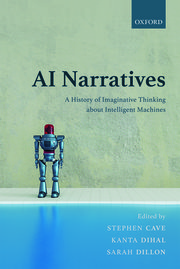
 AI Narratives: A history of imaginative thinking about intelligent machines is a 2020 collective book edited by Stephen Cave, Kanta Dihal, and Sarah Dillon, with about twenty contributing authors, through a series of 16 chapters on the relation between culture (literature, films) and our societal approach to AI, with varying perspectives, some overlap between chapters, a wide range of extrapolation, especially in relation with the oldest books (like Homer’s) and quotes from both books I enjoyed and books I had not heard of, to add to my to-red pile, like Roderick. Predominant place of Blade Runner, of Ĉapek’s Rossum’s Universal Robots, not only for introducing the term, and of Asimov, but also a detailed analysis of the great, thought-provoking, Ann Leckie’s Ancillary Justice. With a realization that Gibson’s Neuromancer had aged quite a lot… For the modern times, very little outside the US-UK realm, as for instance no mention made of Jules Verne or René Barjavel, although Zola makes an appearance when describing workers as automats, neither of the Germanic literature (from the Grimm Brothers onwards), nor of the non-negligible USSR science fiction production, nor yet of the Chinese input, like The three body problem. Other books that could have made it: the Murderbot diaries, and The Alchemy Wars trilogy, for digging into the blurry border between humans and AIs; A Memory Called Empire, for a clever approach to mind uploading, as well as the masterly Never let me go by Ishiguro, both dealing with a future where copies of humans The Amazing Adventures of Kavalier & Clay for the golem, the short story An Unatural Life, for its highly original take on the legal rights of humanoid robots, A Psalm for the Wild-Built because of… tea and Zen monk, obviously!
Among things I learned from AI Narratives, the story of Alan Turing (figuratively) mansplaining Ada Lovelace on her pronouncement that machines cannot be intelligent since they deliver what they are coded for. The mention of automatos in the Illiad. A mention of 1625 Gabriel Naudé Apologie &tc. that excludes magic as irrational, as well as introducing the term androide. The trivia that the creator of the (fraudulent) automaton chess player, Kempelen, also produced in 1791 an authentic if brainless speaking machine. The realisation that E.M Forster also wrote a futuristic novel, The Machine Stops (as well as the precursor of the symbolists, Villiers de l’Isle Adam, with L’Ève Future). Another trivia that cyberpunk first appeared in a 1983 short story by Bruce Bethke. A discussion of the elaborate Culture constructed by Iain Banks, albeit through volumes in the series I hade not read, along with the concept of OCP for outside context problem, akin to Taleb’s Black Swan. The least interesting (and final) chapter in the book is paradoxically the closest to data analysis, when Recchia runs a rather low-tech assessment of a subtitle dataset in relation with AI, if referring to Tufte’s rule of the baselin in the notes (p405).
Definitely enjoyable book, then, even though I mostly skimmed through the chapters during a day-trip to Lille on a Bank (!) holiday. Reading through it made me muse rather belatedly of a parallel between AI scare or adoration, and the non-AI societies, where individuals are (also) part of a structure large enough to miss the larger picture. From building pyramids to being part of the global economy. (This followed mostly from my surprise in seeing Dickens, Trollope, and Zola included in the discussion.)
[Disclaimer about potential self-plagiarism: this post or an edited version will eventually appear in my Books Review section in CHANCE.]
 Read Braking Day, an archi-classic space opera of a spaceship travelling for generations to a substitute planet. With the archi-classic reproduction of earthy behaviours and habits (how on,,, Earth!, one could imagine smoking being allowed on a spaceship? commercial goodies on sale when approaching destination? shopping malls?) Archi-classic heroes as well, standing just on the wrong side of the rules as a shipbound form of smuggling… The no-so-classic is a class A spoiler that emerges half of the book, non-too-soon, and turns the charactera and then some into actual heroes. Very very light and not recommended!
 In-between two weeks in Venice, I cooked a veg curry with (old) butternut, leeks, (new) onions and a yellow species of beetroot I had never seen before, Eaten with my freshly made kimlchi that was somewhat too fresh. The second pot is still burping! And had the worst ramen dish in my culinary experience, in Strasbourg, obviously not the centre of the ramen universe!, where half the ingredients were freezer cold (and the other half just marginaly warmer). (But tasted a new and nice category of curly pasta while in Venice (2), the week before, the Napolitean riccioli!) Also cooked a second sweet potato and cocoa cake for Venice (
 3), which led to a lengthy security check at the CDG airport!


 On
On 


