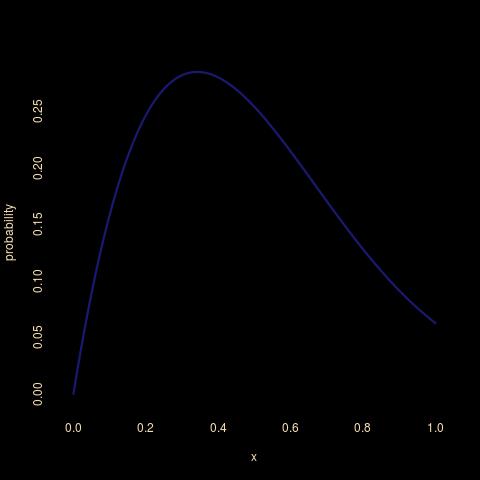
A Riddler puzzle on the three binary and sequential questions one should ask three players hiding their respective U(0,1) realisation, U, V, and W, to best guess which player holds the largest number, max{U,V,W}. Assuming questions of the type Is U<b¹, &tc., the challenge boils down to selecting seven bounds (one for U, two for V, and four for W) in order to optimise the probability of picking the right player. Which means for a given collection of such bounds to learn this probability from the three binary answers. These can be turned into eight (2³) binary variables and I used them as entries in a logistic regression to predict that W was larger than max(U,V), itself predicted by the first two answers. The optimisation of the bounds can then be achieved by simulated annealing (or otherwise) and the approach returns (random) outputs like the following bounds (one on U, two on V, and four on W)
0.616 0.434 0.830 0.350 0.736 0.913 0.796 0.827
for an estimated probability of 0.827. This is a somewhat coherent sequence of bounds when considering the simpler case of two players. Indeed, with three bounds, the probability of winning can be readily derived as

logically optimised by (b¹,b²,b³)=(1/2,1/4,3/4) for a success probability of 0.875. And it coïncides with the solution posted by The Riddler, although there is no intuition behind the figures, contrary to the two player situation. In fact, I am surprised that the bound on W does not equate the expectation of max{U,V} under the current conditions:
> x=runif(1e6,0,.616);y=runif(1e6,0,.434)
> mean(y+(x-y>0)*(x-y))
[1] 0.3591648
 The main BayesComp meeting started right after the ABC workshop and went on at a grueling pace, and offered a constant conundrum as to which of the four sessions to attend, the more when trying to enjoy some outdoor activity during the lunch breaks. My overall feeling is that it went on too fast, too quickly! Here are some quick and haphazard notes from some of the talks I attended, as for instance the practical parallelisation of an SMC algorithm by Adrien Corenflos, the advances made by Giacommo Zanella on using Bayesian asymptotics to assess robustness of Gibbs samplers to the dimension of the data (although with no assessment of the ensuing time requirements), a nice session on simulated annealing, from black holes to Alps (if the wrong mountain chain for Levi), and the central role of contrastive learning à la Geyer (1994) in the GAN talks of Veronika Rockova and Éric Moulines. Victor Elvira delivered an enthusiastic talk on our massively recycled importance on-going project that we need to complete asap!
 In a not-solely-ABC session, I appreciated Sirio Legramanti speaking on comparing different distance measures via Rademacher complexity, highlighting that some distances are not robust, incl. for instance some (all?) Wasserstein distances that are not defined for heavy tailed distributions like the Cauchy distribution. And using the mean as a summary statistic in such heavy tail settings comes as an issue, since the distance between simulated and observed means does not decrease in variance with the sample size, with the practical difficulty that the problem is hard to detect on real (misspecified) data since the true distribution behing (if any) is unknown. Would that imply that only intrinsic distances like maximum mean discrepancy or Kolmogorov-Smirnov are the only reasonable choices in misspecified settings?! While, in the ABC session, Jeremiah went back to this role of distances for generalised Bayesian inference, replacing likelihood by scoring rule, and requirement for Monte Carlo approximation (but is approximating an approximation that a terrible thing?!). I also discussed briefly with Alejandra Avalos on her use of pseudo-likelihoods in Ising models, which, while not the original model, is nonetheless a model and therefore to taken as such rather than as approximation.
 The third and final day of the workshop was shortened for me as I had to catch an early flight back to Paris (and as I got overly conservative in my estimation for returning to JFK, catching a train with no delay at Penn Station and thus finding myself with two hours free before boarding, hence reviewing remaining Biometrika submission at the airport while waiting). As a result I missed the afternoon talks.
 The morning was mostly about using scores for simulation (a topic of which I was mostly unaware), with
 A
A