Archive for Spain

model uncertainty and missing data: an objective BAyesian perspective

Posted in Books, Statistics, Travel, University life with tags , , , , , , , , , , , , , , , , , , , , , , , , , , , , , , , on September 16, 2025 by xi'an

My Spanish and objective Bayesian friends Gonzalo García-Donato, María Eugenia Castellanos, Stefano Cabras, Alicia Quirós, and Anabel Forte wrote an fairly exciting paper in BA that is open to discussion (for a few more days), to be discussed on 05 November (4:00 PM UTC | 11:00 AM EST | 5:00 PM CET).

The interplay between missing data and model uncertainty—two classic statistical problems—leads to primary questions that we formally address from an objective Bayesian perspective. For the general regression problem, we discuss the probabilistic justification of Rubin’s rules applied to the usual components of Bayesian variable selection, arguing that prior predictive marginals should be central to the pursued methodology. In the regression settings, we explore the conditions of prior distributions that make the missing data mechanism ignorable, provided that it is missing at random or completely at random. Moreover, when comparing multiple linear models, we provide a complete methodology for dealing with special cases, such as variable selection or uncertainty regarding model errors. In numerous simulation experiments, we demonstrate that our method outperforms or equals others, in consistently producing results close to those obtained using the full dataset. In general, the difference increases with the percentage of missing data and the correlation between the variables used for imputation.

The so-called Rubin’s identity is simply the representation of the posterior probability of a model γ given the observed data x⁰, p(γ|x⁰), as the integrated posterior probability of a model given both observed and latent data,  p(γ|x⁰, x¹), against the marginal of latent x¹ given observed x⁰. Since this marginal involves the probabilities p(γ|x⁰), this representation is not directly useful for a numerical implementation.

In this paper, missingness relates to some entries of either the covariates or the response variate. Which is less common but more realistic, especially if some covariates do not contribute to the response. (The missingness mechanism does not matter if the data is missing at random (à la Rubin). The computational solution (p9) is rather standard, simulating the missing variables given the observed variables. In my opinion, the elephant in the room is the super-delicate selection of a prior distribution on the missing covariates, as methinks this impacts in a considerable manner the actual value of the Bayes factor, hence the selection of the surviving model. (As a side remark, we are credited in Celeux et al. (2006) to have “extended DIC for missing data models or when missing data were present”, but our point was instead to point out the arbitrariness of the very definition of DIC in such contexts.)

“The standard Bayesian method for addressing the absence of prior information uses improper distributions. In estimation problems (the model is fixed), the impropriety of priors does not imply any additional difficulty as long as the posterior is proper” (p9)

The authors point out the well-known difficulty with improper priors but still resort to improper priors on the parameters shared by all models—which I dispute as being adequate, despite the arguments put forward on p15, right Haar measure or not—, while sticking to proper priors on the model-dependent parameters. Which unsurprisingly become Zellner’s g-priors. Or rather g’-priors, although the discussion seems to resolve into the (model-free) factor g’ being equal to 1 as for the g-priors. Again a strong term in the derivation of the Bayes factor.

integral priors for model comparison [2.0]

Posted in Books, Statistics, University life with tags , , , , , , , , , , , , , , , on May 2, 2025 by xi'an

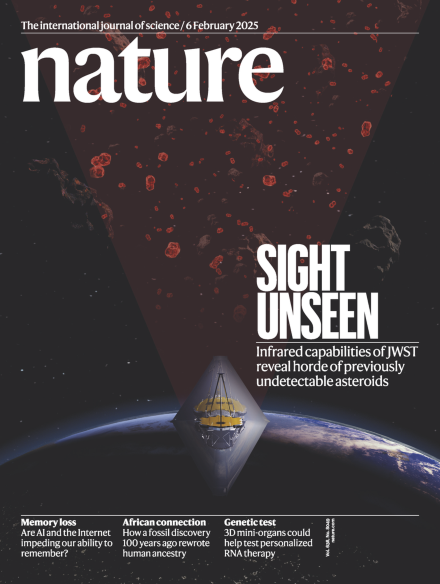
Nature tidbits [06 Feb 2025]

Posted in Statistics with tags , , , , , , , , , , , , , , , , , , , , , , , , , , , , , , , , , , , , , on March 10, 2025 by xi'an

Entries about the scary rise in H5N1 risks of a human transmission, compounded by Trump’s America leaving WHO, hence the US connection with global monitoring and its substantial funding of the organization. Advising against drinking raw milk as a primary precaution. Even camembert?!

A (naïve, imho) call by the presidente of the Union of Concerned Scientists to boost scientific integrity to protect (US) federal research despite the chainsaw massacre unfolding daily in (US) federal agencies. And the disregard of said massacrers for accountability and legal boundaries. And unions, definitely unions.

Also entries (and two Nature collections) on the one hundredth anniversary of the Taung Child fossil uncovering, as the first Australophitecus africanus  that opened the way for the theory that Africa was the birthplace of humanity, along with other extended books reviews. On quantum theory (it’s complicated!, according to Sean Carroll) and Kepler mission (by Jason Steffen). And a show at Cité des Sciences in La Villette about silence that I would love to attend.

A quick assessment of deepseek against its competitors. Mostly praising its open code. And another one on 23andMe losses and trouble,  reflecting the one-shot strategy of the company that cannot sell its analysis more than once (despite repeatedly trying, as I can confirm from their frequent emails). And opening concerns about their data or rather our data. Since there is very little protection in the US for this kind of data, considered out of healthcare.

New challenges of large carnivores in Western Europe, with a rise of wolverines, success story for the Iberian lynx, talks of reintroducing wolves to Scotland (to cull red deer like those who roam Buachaille Mor), degrading setting in France with looser rules for shooting wolves.

Microplastics in the brain, unsurprisingly increasing the chances of clots and surprisingly easily moving into blood vessels and the brain. And, speakiMicroplastics in the brainng of plastic, recycling, at last? Warwick Manufacturing Group (WMG) mentioned as evaluating the life-cycle analysis of a new approach with superheated water. Exposing the elephant in the room, namely that there is very little true recycling going on and that part of the recycled plastic ends up as fuel, hence contributing to pollution. Costs and impact of turning used products into new material are mentioned (and staggering albeit not compared with the initial costs and impact.

And I remain perplexed by the Two-Eyed Seeing Indigenous perspective for neuroscience article. As I do not see the scientific component, besides directions to work with local communities.

Jacob Kiplimo set world ½ marathon record in 56:42

Posted in pictures, Running with tags , , , , , , , , on February 17, 2025 by xi'an

stats postdoc in Barcelona

Posted in Statistics, Travel, University life with tags , , , , , , , , , , , , on April 5, 2022 by xi'an

Here is a call for exciting postdoc positions in high-dimensional statistics for network & graphical models analysis, Barcelona:

We have two post-doctoral positions to work on a range of topics related to high-dimensional statistics for networks, ultra high-dimensional graphical models, frameworks linking networks and graphical models, multivariate structural learning and time series analysis. The positions are for 1 year, with a potential for extension to 18 months, with a gross yearly salary of 40,000€. The scope is ample and allows for sub-projects related to mathematical statistics and statistical learning theory, data analysis methodology in penalized likelihood and Bayesian statistics, and computational methods. The positions are related to a Huawei grant, which also offers opportunities to explore applications of the developed theory & methods.

The project is primarily hosted by the Statistics group at UPF and the BSE Data Science Center in Barcelona (Spain), and is in collaboration with Luc Devroye at McGill University in Montreal (Canada) and Piotr Zwiernik at the University of Toronto (Canada). The primary supervisors are Christian Brownlees, Luc Devroye, Gábor Lugosi, David Rossell and Piotr Zwiernik, although collaborations with other professors of these research groups are also possible.

Interested candidates should send an updated CV and a short research statement to David Rossell (david.rossell AT upf.edu). They should ask 3 referees to send a letter of reference on their behalf.

The deadline for applying for the first position is April 30 2022, the deadline for the second position is June 15 2022.