
Archive for xkcd
the problem with non-stationary processes [xkcd]
Posted in Statistics with tags Agent Orange, Donald Trump, political polls, predictions, Stand Up To Trump, stationarity, US elections 2024, US politics, USA, xkcd on November 7, 2024 by xi'an
algorithmic complexity
Posted in Books, Kids, Statistics, University life with tags algorithms, computational complexity, computing time, webcomic, xkcd on July 31, 2024 by xi'an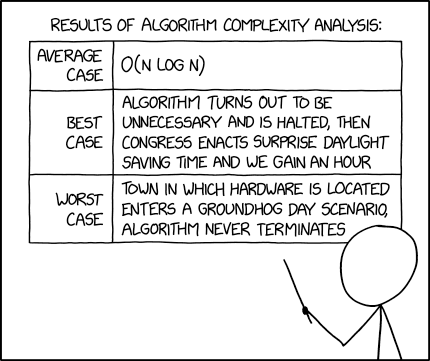
prediction by Google trends
Posted in Books, Kids, pictures with tags comics, Google, Google trends, solar cycle, webcomic, xkcd on July 9, 2024 by xi'an
slow learning [xkcd]
Posted in Statistics with tags 1776, Arvid Högbom, CO2, greenhouse-gas emissions, industrial revolution, James Watt, Randall Munroe, Svante Arrhenius, webcomic, xkcd on April 14, 2024 by xi'an
Contextual Integrity for Differential Privacy #1 [23w5106]
Posted in Books, Mountains, pictures, Statistics, University life with tags Banff International Research Station for Mathematical Innovation, BIRS, British Columbia, Canada, contextual integrity, differential privacy, ethics, Gibbs posterior, Kelowna, Okanagan Valley, philosophy of sciences, safe Bayes, score function, UBCO, workshop, xkcd on August 2, 2023 by xi'an
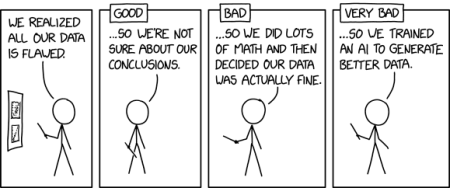 Very relaxed beginning to the workshop, with [xkcd illustrated] tutorials on CI and DP, plus informal discussions to find a common ground over the week. Helped by the beautiful surroundings of the UBC Okanagan campus. Tutorial on the fundamentals of differential privacy, with a long room discussion on the meaning(s) of the definition, for instance exhibiting the minimax nature of the thing, placing all bad events at the same level. Any Bayesian version? Still unclear [to me] how one can inverse-engineer (ε,δ) into the probability of identifying one data entry. More questions about the nature of noise in DP algorithms. Again lacking [for me] the impact on identifying one data entry. Plus notions like Laplace privacy-accuracy sound parameterisation dependent. Exponential mechanism, that involves a score function (protecting privacy?) that ends up resembling a Gibbs posterior in the “safe Bayes” perspective. Interesting distinction about which agent provides randomness as impacting the privacy.
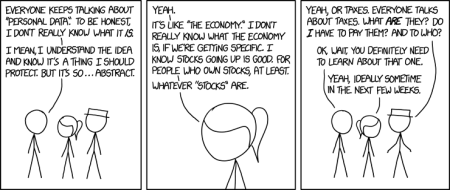 As for contextual integrity, presented by Helen Nissenbaum at the origin of the concept, it is complicated by a strongly subjective handling of notions, first and foremost privacy, as inevitably the case in philosophy and ethics.


