Archive for Zig-Zag

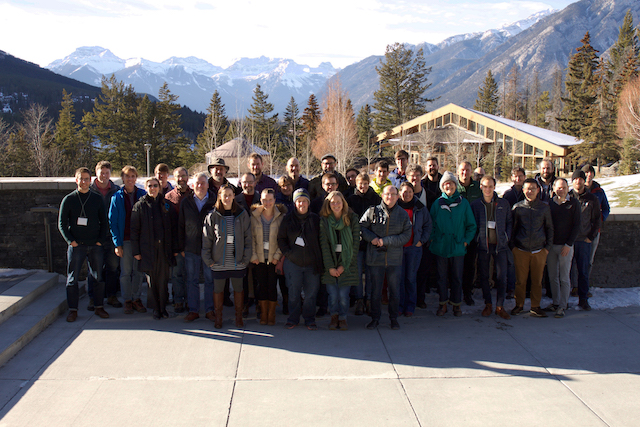
computational statistics and molecular simulation [18w5023]

Posted in pictures, Statistics, Travel, University life with tags , , , , , , , , , , , , , , , , , , , , , , , on November 14, 2018 by xi'an

On Day 2, Carsten Hartmann used a representation of the log cumulant as solution to a minimisation problem over a collection of importance functions (by the Vonsker-Varadhan principle), with links to X entropy and optimal control, a theme also considered by Alain Dunmus when considering the uncorrected discretised Langevin diffusion with a decreasing sequence of discretisation scale factors (Jordan, Kinderlehrer and Otto) in the spirit of convex regularisation à la Rockafellar. Also representing ULA as an inexact gradient descent algorithm. Murray Pollock (Warwick) presented a new technique called fusion to simulate from products of d densities, as in scalable MCMC (but not only). With an (early) starting and startling remark that when simulating one realisation from each density in the product and waiting for all of them to be equal means simulating from the product, in a strong link to the (A)BC fundamentals. This is of course impractical and Murray proposes to follow d Brownian bridges all ending up in the average of these simulations, constructing an acceptance probability that is computable and validating the output.

The second “hand-on” lecture was given by Gareth Roberts (Warwick) on the many aspects of scaling MCMC algorithms, which started with the famous 0.234 acceptance rate paper in 1996. While I was aware of some of these results (!), the overall picture was impressive, including a notion of complexity I had not seen before. And a last section on PDMPs where Gareth presented very recent on the different scales of convergence of Zigzag and bouncy particle samplers, mostly to the advantage of Zigzag.In the afternoon, Jeremy Heng presented a continuous time version of simulated tempering by adding a drift to the Langevin diffusion with time-varying energy, which must be solution to the Liouville pde \text{div} \pi_t f = \partial_t \pi_t. Which connects to a flow transport problem when solving the pde under additional conditions. Unclear to me was the creation of the infinite sequence. This talk was very much at the interface in the spirit of the workshop! (Maybe surprisingly complex when considering the endpoint goal of simulating from a given target.) Jonathan Weare’s talk was about quantum chemistry which translated into finding eigenvalues of an operator. Turning in to a change of basis in a inhumanly large space (10¹⁸⁰ dimensions!). Matt Moore presented the work on Raman spectroscopy he did while a postdoc at Warwick, with an SMC based classification of the peaks of a spectrum (to be used on Mars?) and Alessandra Iacobucci (Dauphine) showed us the unexpected thermal features exhibited by simulations of chains of rotors subjected to both thermal and mechanical forcings, which we never discussed in Dauphine beyond joking on her many batch jobs running on our cluster!

And I remembered today that there is currently and in parallel another BIRS workshop on statistical model selection [and a lot of overlap with our themes] taking place in Banff! With snow already there! Unfair or rather #unfair, as someone much too well-known would whine..! Not that I am in a position to complain about the great conditions here in Oaxaca (except for having to truly worry about stray dogs rather than conceptually about bears makes running more of a challenge, if not the altitude since both places are about the same).

coordinate sampler as a non-reversible Gibbs-like MCMC sampler

Posted in Books, Kids, Statistics, University life with tags , , , , , , , , on September 12, 2018 by xi'an

In connection with the talk I gave last July in Rennes for MCqMC 2018, I posted yesterday a preprint on arXiv of the work that my [soon to defend!] Dauphine PhD student Changye Wu and I did on an alternative PDMP. In this novel avatar of the zig-zag sampler,  a  non-reversible, continuous-time MCMC sampler, that we called the Coordinate Sampler, based on a piecewise deterministic Markov process. In addition to establishing the theoretical validity of this new sampling algorithm, we show in the same line as Deligiannidis et al.  (2018) that the Markov chain it induces exhibits geometrical ergodicity for distributions which tails decay at least as fast as an exponential distribution and at most as fast as a Gaussian distribution. A few numerical examples (a 2D banana shaped distribution à la Haario et al., 1999, strongly correlated high-dimensional normals, a log-Gaussian Cox process) highlight that our coordinate sampler is more efficient than the zig-zag sampler, in terms of effective sample size.Actually, we had sent this paper before the summer as a NIPS [2018] submission, but it did not make it through [the 4900 submissions this year and] the final review process, being eventually rated above the acceptance bar but not that above!

MCqMC 2018, Rennes [slides]

Posted in Statistics with tags , , , , , on July 3, 2018 by xi'an

Here are my slides for the talk I give this morning at MCqMC 20188. Based on slides first written by Changye Wu and on our joint papers. As it happens, I was under the impression I would give a survey on partially deterministic Markov processes. But, as it goes (!), my talk takes place after a superb plenary talk by Christophe Andrieu on non-reversibility, where he gave motivations for recoursing to non-reversibility and general results for variance reduction, plus a whole session on the topic by Jorens Bierkens, Alex Thiéry, Alain Durmus, and Arnak Dalalyan (CREST), which covered the topics in the following slides, only better! Reducing the informative contents of my talk to the alternative to the Zig-Zag sampler Changye proposed, which makes the talk of limited appeal, I am afraid. (There are four other sessions at the same time, fortunately!)

zig, zag, and subsampling

Posted in Books, Statistics, University life with tags , , , , , , , , , on December 29, 2016 by xi'an

ENSAE, Nov. 17, 2010Today, I alas missed a seminar at BiPS on the Zig-Zag (sub-)sampler of Joris Bierkens, Paul Fearnhead and Gareth Roberts, presented here in Paris by James Ridgway. Fortunately for me, I had some discussions with Murray Pollock in Warwick and then again with Changye Wu in Dauphine that shed some light on this complex but highly innovative approach to simulating in Big Data settings thanks to a correct subsampling mechanism.

The zig-zag process runs a continuous process made of segments that turn from one diagonal to the next at random times driven by a generator connected with the components of the gradient of the target log-density. Plus a symmetric term. Provided those random times can be generated, this process is truly available and associated with the right target distribution. When the components of the parameter are independent (an unlikely setting), those random times can be associated with an inhomogeneous Poisson process. In the general case, one needs to bound the gradients by more manageable functions that create a Poisson process that can later be thinned. Next, one needs to simulate the process for the upper bound, a task that seems hard to achieve apart from linear and piecewise constant upper bounds. The process has a bit of a slice sampling taste, except that it cannot be used as a slice sampler but requires continuous time integration, given that the length of each segment matters. (Or maybe random time subsampling?)

A highly innovative part of the paper concentrates on Big Data likelihoods and on the possibility to subsample properly and exactly the original dataset. The authors propose Zig-Zag with subsampling by turning the gradients into random parts of the gradients. While remaining unbiased. There may be a cost associated with this gain of one to n, namely that the upper bounds may turn larger as they handle all elements in the likelihood at once, hence become (even) less efficient. (I am more uncertain about the case of the control variates, as it relies on a Lipschitz assumption.) While I still miss an easy way to implement the approach in a specific model, I remain hopeful for this new approach to make a major dent in the current methodologies!

retrospective Monte Carlo

Posted in pictures, Running, Statistics, Travel, University life with tags , , , , , , , , , , on July 12, 2016 by xi'an

the pond in front of the Zeeman building, University of Warwick, July 01, 2014The past week I spent in Warwick ended up with a workshop on retrospective Monte Carlo, which covered exact sampling, debiasing, Bernoulli factory problems and multi-level Monte Carlo, a definitely exciting package! (Not to mention opportunities to go climbing with some participants.) In particular, several talks focussed on the debiasing technique of Rhee and Glynn (2012) [inspired from von Neumann and Ulam, and already discussed in several posts here]. Including results in functional spaces, as demonstrated by a multifaceted talk by Sergios Agapiou who merged debiasing, deburning, and perfect sampling.

From a general perspective on unbiasing, while there exist sufficient conditions to ensure finite variance and aim at an optimal version, I feel a broader perspective should be adopted towards comparing those estimators with biased versions that take less time to compute. In a diffusion context, Chang-han Rhee presented a detailed argument as to why his debiasing solution achieves a O(√n) convergence rate in opposition the regular discretised diffusion, but multi-level Monte Carlo also achieves this convergence speed. We had a nice discussion about this point at the break, with my slow understanding that continuous time processes had much much stronger reasons for sticking to unbiasedness. At the poster session, I had the nice surprise of reading a poster on the penalty method I discussed the same morning! Used for subsampling when scaling MCMC.

On the second day, Gareth Roberts talked about the Zig-Zag algorithm (which reminded me of the cigarette paper brand). This method has connections with slice sampling but it is a continuous time method which, in dimension one, means running a constant velocity particle that starts at a uniform value between 0 and the maximum density value and proceeds horizontally until it hits the boundary, at which time it moves to another uniform. Roughly. More specifically, this approach uses piecewise deterministic Markov processes, with a radically new approach to simulating complex targets based on continuous time simulation. With computing times that [counter-intuitively] do not increase with the sample size.

Mark Huber gave another exciting talk around the Bernoulli factory problem, connecting with perfect simulation and demonstrating this is not solely a formal Monte Carlo problem! Some earlier posts here have discussed papers on that problem, but I was unaware of the results bounding [from below] the expected number of steps to simulate B(f(p)) from a (p,1-p) coin. If not of the open questions surrounding B(2p). The talk was also great in that it centred on recursion and included a fundamental theorem of perfect sampling! Not that surprising given Mark’s recent book on the topic, but exhilarating nonetheless!!!

The final talk of the second day was given by Peter Glynn, with connections with Chang-han Rhee’s talk the previous day, but with a different twist. In particular, Peter showed out to achieve perfect or exact estimation rather than perfect or exact simulation by a fabulous trick: perfect sampling is better understood through the construction of random functions φ¹, φ², … such that X²=φ¹(X¹), X³=φ²(X²), … Hence,

X^t=\varphi^{t-1}\circ\varphi^{t-2}\circ\ldots\circ\varphi^{1}(X^1)

which helps in constructing coupling strategies. However, since the φ’s are usually iid, the above is generally distributed like

Y^t=\varphi^{1}\circ\varphi^{2}\circ\ldots\circ\varphi^{t-1}(X^1)

which seems pretty similar but offers a much better concentration as t grows. Cutting the function composition is then feasible towards producing unbiased estimators and more efficient. (I realise this is not a particularly clear explanation of the idea, detailed in an arXival I somewhat missed. When seen this way, Y would seem much more expensive to compute [than X].)