 Over the past weeks, I have revised Reading Keynes’ Treatise on Probability and the new version is now arXived (and resubmitted). I have mostly focussed on the presentation of the Treatise within the (then) current scene and on the existing advances missed by Keynes, rather than studying the technical work on the principal averages any further. For the same reason, I also abstained from relating the book to the notion of uncertain probabilities, despite a nice suggestion by Michael Brady, as I felt this was not directly related to the statistical focus of the review.
Archive for A Treatise on Probability
“Reading Keynes” revised
Posted in Books, Statistics, University life with tags A Treatise on Probability, John Maynard Keynes on October 19, 2010 by xi'anreading Keynes [assessed]
Posted in Books, Statistics, University life with tags A Treatise on Probability, Harold Jeffreys, John Maynard Keynes on October 1, 2010 by xi'an A few days ago, I got the following review of my paper on Keynes’ A Treatise on Probability, review which, while being rather negative, is quite fair.
When I looked at the title, I was expecting a paper that would be of considerable general interest. Now that I have read the paper several times, I am not quite sure what I got out of the paper. While I admire the authors goal, the paper is unfortunately not very informative.. [It] comes across as a collection of disjoint points. Even within sections, the points being made are not cohesive, and the paper does not flow smoothly. Some of this is to be expected from the nature of the paper, as one must select key points to discuss. But the organization has to be better. Also, the material following the quotes do not really embellish on the point in the quote; in fact, sometimes there is no direct connection. Take for instance the first part of Section 2, before 2.1. The quote just sits there the material doesn’t make any connection to it. The main point of the section is in the top para on page 3 but it doesn’t do much. There is a mention on lack of analyses of data but this seems to be a throw-away sentence. Continue reading
arXives
Posted in Books, Statistics with tags A Treatise on Probability, Annals of Statistics, arXiv, Bayesian Analysis, John Maynard Keynes, Krzysztof Burdzy, The Search for Certainty on March 31, 2010 by xi'anYesterday, I finally arXived my notes on Keynes’ book A Treatise On Probability, but, due to the new way the arXiv website operates, there is no indication of the page associated with the submitted paper before it gets accepted and I cannot thus prepare an Og’ entry until this acceptance, wasting perfect timing! Anyway, this is the first draft of the notes and it has not yet been submitted to a journal. As the new user interface on the arXiv webpage now displays all past papers, I added a category on our 2007 Annals paper with Randal Douc, Arnaud Guillin and Jean-Michel Marin, which means it appeared again in today’s list…
Today I completed my revision of the review of Burdzy’s The Search for Certainty over for Bayesian Analysis, so the new version will be on arXiv tomorrow morning. The changes are really minor as Bayesian Analysis mostly requested smoothing down my criticisms. I also added a few more quotes and some sentences in the conclusion. I wonder if this paper will appear with a discussion, since three are already written!
At last, let me point out three recent interesting postings on arXiv if I do not have time to discuss them more in depth, one by Peter Green on Colouring and breaking sticks: random distributions and heterogeneous clustering, one by Nicolas Chopin, Tony Lelièvre et Gabriel Stolz on Free energy methods for efficient exploration of mixture posterior densities, and one by Sophie Donnet and Jean-Michel Marin on An empirical Bayes procedure for the selection of Gaussian graphical models.
Keynes’ derivations
Posted in Books, Statistics with tags A Treatise on Probability, Gauss, harmonic mean estimator, John Maynard Keynes, Laplace, maximum likelihood estimation on March 29, 2010 by xi'an Chapter XVII of Keynes’ A Treatise On Probability contains Keynes’ most noteworthy contribution to Statistics, namely the classification of probability distributions such that the arithmetic/geometric/harmonic empirical mean/empirical median is also the maximum likelihood estimator. This problem was first stated by Laplace and Gauss (leading to Laplace distribution in connection with the median and to the Gaussian distribution for the arithmetic mean). The derivation of the densities


is satisfied for one of the four empirical estimate, using differential calculus (despite the fact that Keynes earlier derived Bayes’ theorem by assuming the parameter space to be discrete). Under regularity assumptions, in the case of the arithmetic mean, my colleague Eric Séré showed me this indeed leads to the family of distributions

where 



a constraint missed by Keynes.
While I cannot judge of the level of novelty in Keynes’ derivation with respect to earlier works, this derivation therefore produces a generic form of unidimensional exponential family, twenty-five years before their rederivation by Darmois (1935), Pitman (1936) and Koopman (1936) as characterising distributions with sufficient statistics of constant dimensions. The derivation of the distributions for which the geometric or the harmonic means are MLEs then follows by a change of variables, 


at the bottom of page 198, which is not integrable in 


instead of 

(where the integral ought to be interpreted as a primitive) is such that the recovery of Laplace’s distribution, 
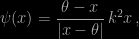
hence making 

with the difficulties that the distribution only vaguely depends on 

Given that this part is the most technical section of the book, this post shows why I am fairly disappointed at having picked this book for my reading seminar. There is no further section with innovative methodological substance in the remainder of the book, which now appears to me as no better than a graduate dissertation on the probabilistic and statistical literature of the (not that) late 19th century, modulo the (inappropriate) highly critical tone.
More on Treatise
Posted in Books, Statistics with tags A Treatise on Probability, Harold Jeffreys, John Maynard Keynes, Theory of Probability on March 25, 2010 by xi'an When writing my review of Keynes’ A Treatise On Probability, I found that there is a very detailed review paper by John Aldrich (2008) that covers the beginnings of Keynes as a statistician, entitled “Keynes among the Statisticians” (sic!) and published in the journal History of Political Economy. This review is incredibly helpful in resetting the book in the conditions at the time. I also discovered through this review that Harold Jeffreys reviewed A Treatise On Probability in Nature and that Dennis Lindley wrote an Encyclopedia entry on Keynes, no less…


