Today the program of 12w5105 was more on the theoretical side with adaptive MCMC in the morning and ABC in the afternoon. Éric Moulines and Gersende Fort shared a talk on two papers, one on adaptive tempering and the other one on equi-energy sampling, then Nando de Freitas spoke first about Gaussian process approximation for Bayesian optimisation, then about an adaptive Hamiltonian technique called Sardonics. And Jeff Rosenthal concluded the morning with a review of the results ensuring convergence for adaptive MCMC (with a delightful counter-example called Stairways to Heaven that reminded me of an ice climb in Utah!). After my talk, where Scott Sisson made an interesting comment on the difficulty to extend our framework to a large collection of models (since then the summary statistics have to differ), François Perron discussed in highly interesting details several approximation techniques for the Bayesian estimation of copulas and Scott Sisson presented his recent arXiv paper where a rough estimate of the joint posterior is obtained regression-adjustment ABC, and then estimates of each marginal posterior distribution are separately obtained in a lower-dimensional analysis, all this being connected with Bayes linear analysis. (I do not completely get the way summary statistics are selected for each marginal there, which seems to be done by hand. While I understand why using a lower-dimensional statistic helps in improving the approximation of the marginal posteriors and fights the curse of dimensionality, the fact that the joint posterior sample is based on different summary statistics for the different components makes an interesting statistical puzzle. Maybe the copula approach by François in the previous talk could be used at the final stage.) The final talk by Zhiqiang Tan on comparative performances of resampling and subsampling strategies generated a very animated discussion. (All talks being recorded, mine is available as an mp4 video but watch at your own peril!)
Archive for BIRS
Banff workshop [BIRS 12w5105 meeting [#2]]
Posted in Mountains, pictures, Statistics, Travel, University life with tags 12w5105, ABC, adaptive MCMC methods, Banff, Banff National Park, BIRS, MCMC, Mount Rundle, resampling, video on March 21, 2012 by xi'anBanff worshop [BIRS 12w5105 meeting]
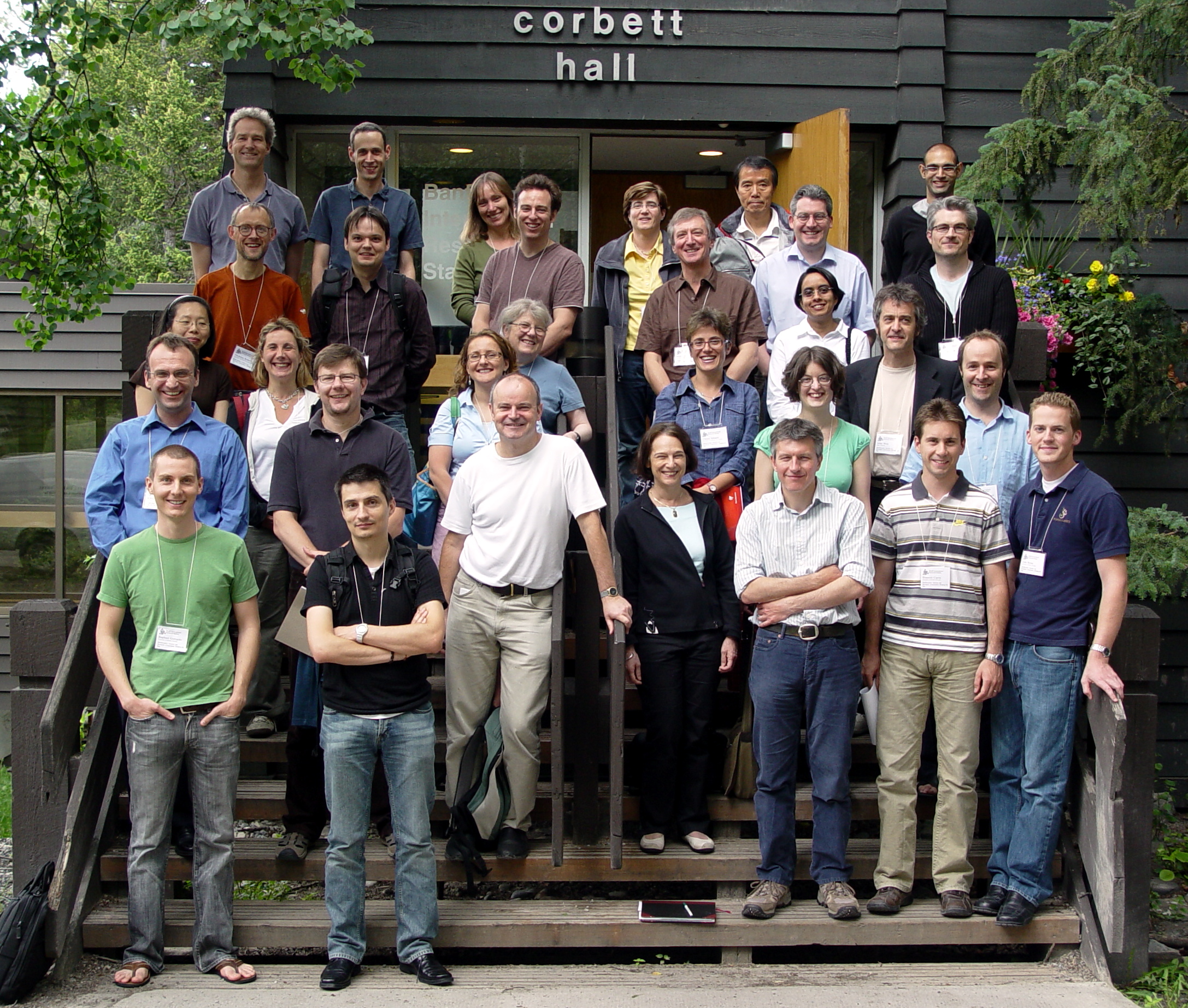
Posted in Mountains, pictures, Statistics, Travel, University life with tags ABC, Banff, BIRS, Canada, Mount Rundle on March 20, 2012 by xi'an The workshop 12w5105 at BIRS, Banff, has now started for good! To wit, we had the customary group photo outside the TransCanada Pipeline Pavilion where BIRS is now hosted. (With Mount Rundle as a guest star!) The first day saw talks by or on physics, astrophysics, and genetics. In particular, Dawn Woodard gave a particularly stimulating talk on the fine convergence analysis of Liu et al.’s (1995) seminal Gibbs algorithm: The most striking result related to an exponential decay in the spectral gap with the number of observations þ when the entropy is multimodal and the Markov chain jumps are also decreasing exponentially with þ. (As usual, I had trouble relating to the physics talks, more because of the vocabulary and of the focus than because of the contents… They sounded quite exciting, though, in their connections with correlated sampling and simulated annealing.) Here are the slides of my talk for tomorrow.
back to Banff
Posted in Mountains, pictures, Statistics, Travel, University life with tags Banff, Banff National Park, BIRS, MCMC, Monte Carlo Statistical Methods, simulation on March 18, 2012 by xi'an


After a mostly cloudy flight over Greenland, I landed in Calgary this afternoon and am now in Banff for this exciting MCMC workshop! Also looking forward a hike with Devin tomorrow, hoping the weather will not turn to heavy snow!
Magical Mathematics [and the converse]
Posted in Books, Kids, Mountains, Travel, University life with tags Banff, BIRS, book review, card tricks, combinatorics, de Bruijn sequences, Madelbrot set, magics, Persi Diaconis, sleight of hand on December 29, 2011 by xi'an“The two of us have been mixing entertainment with mathematics for most of our lives.” (page xi)
 When I learned that Persi Diaconis and Ron Graham had co-authored a book on the mathematics of magic, the Book Editor of CHANCE immediately asked Princeton University Press for a copy! Even though I am not at all interested in card tricks. Nor in juggling. (The title is a wee confusing to [a non-native speaker like] me as it sounds as focussing on the magics of mathematics rather than the converse.)
Once the book had arrived, I showed the book to my wife and she started reading it right away, going over the first chapter prior to giving it back. Later, on a plane trip between Phoenix and Minneapolis, I happened to sit next to a professional magician, The Amazing Hondo!, who started chatting with me and telling me about his work and some of his tricks. He knew about Persi as a magician but was surprised he was equally famous among mathematicians. Hondo showed me a few (impressive) sleights of hand and explained a nice mathematical trick (based on creating apparent randomness while always extracting the same number of cards from the pile). As I happened to have the book with me, he took a look at it, commenting on one trick, and wrote down the reference. I have had a few other occurrences of how the book attracted the attention of non-magicians and/or non-mathematicians: this illustrates the appeal of the concept of this book for a very wide audience and, of course, once one starts reading the book, the attaction is increased manyfold. It is indeed a very entertaining book, with a fairly easy mathematical level, and it is also a beautiful product, with wide margins, fancy (but readable) fonts, photographs, and graphs or tables in the margins.
“Both of our worlds have a dense social structure: thousands of players turning ideas over and over.” (page xi)
The entertaining and cosy style of Mathematical Magics (oops, Magical Mathematics!) does not mean it is an easy read. First, conceptualising the card manipulations requires a good analytic mind if one does not have a deck of cards available. Second, the connections with mathematics involve several subfields and not only combinatorics. Like de Bruijn sequences and graphs, the Mandelbrot set, Penrose tiling. And even Bayesian analysis for reversible Markov chains (p.42) and the I Ching… The last chapters are however less directly related to maths (even though Chapter 10 about great mathematical magicians includes connections with topology).
Interestingly (for us academics), the book mentions a (Banff) BIRS 2004 workshop relating to magics via de Bruijn sequences and Gray codes. With the traditional picture in front of the (old) BIRS building. (Another item of information, IBM stands for International Brotherhood of Magicians!)
“We hope that our book will shine a friendly light on the corners of the world that are our homes.” (page xii)
 One of the complaints I share with my wife about Magical Mathematics is that some of the tricks are not explained in full enough detail. At least for some non-native speakers like us. For instance, during my skiing break in the Alps, Paul my nephew and I tried the Gilbreath principle and could not make it work without forcing the perfect riffle-shuffle one card at a time. The sentence “the shuffle doesn’t have to be carefully done” (p.63) set us on the wrong track. On pages 106 and 107, two 1500’s books in French are quoted with one typo (sont versus font, but at the time s and f were typed quite similarly), a missing s in Inventions, and without the accents: I wonder whether or not accents existed at the time. (It seems they did not, as seen on the originals here and there.) The comment on Heeffer’s 1624 (French) book is confusing [to me] in that Heeffer is a current math historian working on a 1624 book by Jean Leurechon. (The accents are not there in the 1624 edition.)
Overall, this is a wonderful book, potentialy enjoyable by a large range of individuals. (Precision: I read half of it flying over the beauty of sunsetted Greenland and the other half in a chalet next to the ski slopes. So I was in a mellow spirit!) The order behind the apparent randomness of card tricks becomes clearer and clearer to the naïve reader like me.And the warmth and communal spirit of the magician community transpires through the last chapters. (Note there is a $1000 reward posted within the book!)
Banff workshop
Posted in Mountains, Statistics, Travel, University life with tags Banff, BIRS, Canada, Edinburgh, ICMS, MCMC, Monte Carlo Statistical Methods, Scotland, workshop on August 29, 2011 by xi'an Great! I have been invited to take part in the Challenges and Advances in High Dimensional and High Complexity Monte Carlo Computation and Theory workshop (12w5105) in BIRS, Banff, next March. Given the participants confirmed so far, the prospect of meeting with “leading researchers who work at the cutting edge of scientific research in physics, chemistry, computer science, genetics and medicine”, and the fantastic facilities provided by BIRS, it is obviously a great opportunity to exchange and progress about the current state of the Monte Carlo methods (in Statistics), about a month before the workshop we organise on a similar theme at ICMS, Edinburgh, with Mark Girolami and Antonietta Mira. I am definitely and eagerly looking forward to this “MCMCanff” event! (And of course to the pleasure of discovering Banff and the nearby mountains in the winter!)