Archive for book review

Nature tags & snippets [19 Feb 2026]

Posted in Books, pictures, University life with tags , , , , , , , , , , , , , , , , , , , , , on March 24, 2026 by xi'an

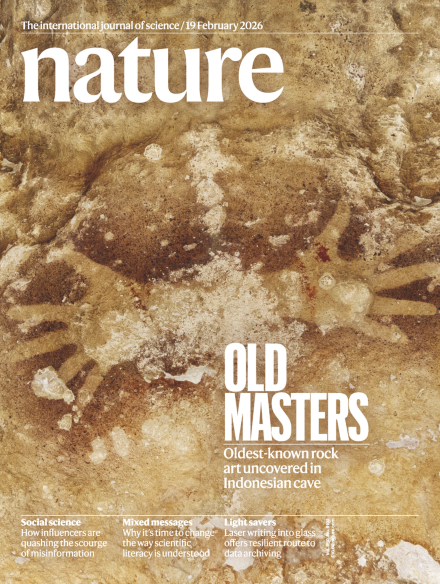
The cover of this 19 Feb edition of Nature is made of an hand pencilled on an Indonesian cave, possibly the oldest piece of art discovered so far. By an ancient precursor of Jean-Michel Basquiat… On more current issues,

A tribune on UKRI cutting whole branches of medical, biological and physical research in the UK, to “focus and do fewer things better¨. Impacting for instance the Medical Research Council (MRC). At least until 2028, with longer range consequences.

And an entry on Epstein, whose files have now contaminated even Nature itself. (When is Andrews MW going to make an appearance there as well?!) The connection (of interest) with science is that the sex offender and financier supported research institutions, incl. the mathematical biologist Martin Nowak, whose work Epstein reviewed (despite a total absence of credentials!). Along another entry on the Chinese Government (MOST) instituting penalties on universities failing to act on scientific misconduct by some of their staff.

And a frightful graph on the exploding number of measles cases in the US, this year, related to the drop in the proportion of vaccinated children. Correlated with the next article on regulation moves by the Trump administration to make firing government scientists much easier. And with the surge in US applicants to the major European grants, namely ERC starting, consolidator and advanced grants and Marie Skłodowska-Curie postdoctoral fellowships.

A book review of Michael Pollan’s A World Appears: A Journey into Consciousness, a New York Times bestseller and more importantly an exploration of the physical nature of consciousness. Followed by a long comment by N. Sanders (Harvard) and B. Schneier (Toronto) on the pernicious effect of high salaries in AI companies on academic research, in particular by negating the scientific worth of collaborating. Plus a regular one-column comment that “Statistical approximation is not general intelligence”..! Albeit with reasonable arguments about the unlikely emergence of an artificial general intelligence.

Last but not least, a Perspective article on the moral competence of large language models. which requires defining first moral competence and moral performances. Involving a long-term acquaintance of mine’s, Kristian Lum (now at DeepMind NY) as one of the authors.
lost science

Posted in Books, pictures, Statistics, Travel, University life with tags , , , , , , , , , , , , , , , , , , , , , , , , on February 22, 2026 by xi'an

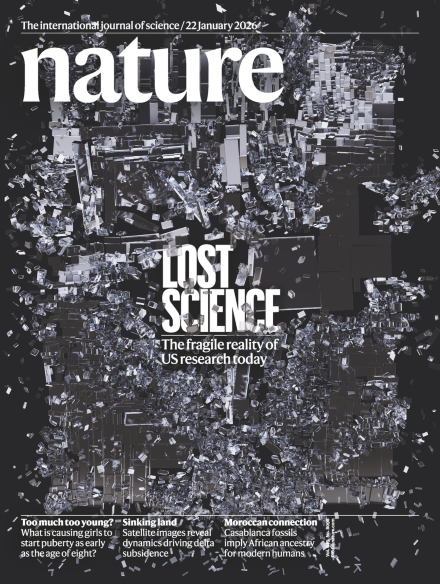
The on-going Orange chainsaw massacre on US science is taking a significant chunk of 22 Jan issue of Nature. With prognosis for 2026, and more of the same, special maps on quantifying the impact of 2025 Federal cuts, scientists reflecting on disrupted careers and best ways of fighting back. Plus a book review of The Great Global Transformation by Branko Milanovic (to appear), which explores how globalization and the rise of new elites has induced a parallel growth in nationalism and greed. Which strongly correlates with the Orange disaster. (As a funny aside, both the authors of Why China Will not Rule the World and of When China Rules the World are quoted for their positive reviews!)

On the 2026 US budget prospects, the battle between the Trump administration and the US Congress will a.s. (hopefully!) continue, incl. the cuts to indirect costs, the politisation of grant panels, the drop in foreign student applications and conference attendees. The maps are making much more sense through Nature interactive page than on paper. Since the Mondrian-like maps that represent grant cuts and cancellations according to state, funding source (NIH, NSF—from which direction our Ottawa U friend Panchanathan resigned last April), court reinstatement, and topics. Still, the dynamic change of colours and the lack of scale make these poor or even terrible graphs. Over-optimistic scientists consider reimagining higher education towards public needs (to be distinguished from populist and conspirationist calls on which ground?!), turning to philanthropic support (with highly uncertain long-term prospects, seeing how quickly high-tech moguls turned their jackets under Orange pressure!), and the remaining entries are just wistful thinking… The UCS (Union of Concerned Scientists) is reported documenting 536 attacks of the Trump administration on science and scientific integrity, not counting harassment and intimidation, but this pales against the several thousand federal scientists who have fired and the remaining ones who (still) work in federal agencies under several swords of Damocles, from abruptly cut funding, to newly prohibited domains of research, like health disparities and sexual diseases, to firing, and to visa cancellation… Not a comforting read, this 22 Jan issue of Nature, when realising how massive, deep, long-term-impacting, the havoc the Trump administration has wreaked (or wrought!) on science as much as economy and international relations.

Nature tidbits [11 Dec 2025]

Posted in Books, Kids, pictures, Travel with tags , , , , , , , , , , , , , , , on January 25, 2026 by xi'an

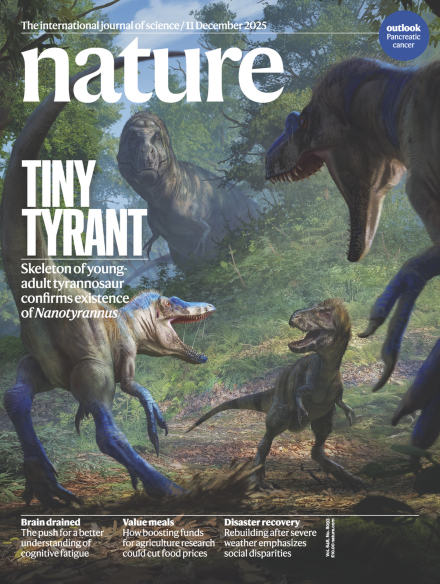
This issue of Nature features dinosaurs on its cover, as in old-time science magazines, yay! In association with a new (tiny) species of tyrannosaurus.

On the Trump 2.0 disaster scene, a reflection on the dangers of the Genesis Mission, which directed by the US Department of Energy to create AI scientists–and give AI companies access to federal datasets. Trump’s attempt to have his own (obviously Big & Beautiful) Manhattan Project?! Unsurprisingly, sounds very messy at this stage.

ICLR 2026 being exposed having 21% of the reviews are fully AI generated using tools from Pangram Labs, in New York. (And around 10% of the submissions being mostly written by AIs as well.) The inevitable evolution of the machine learning conference reviewing process?! Plus a review of the impact of Alphafold for its fifth anniversary. And a discussed paper by Oh & al. on meta-learning, conceiving reinforced learning algorithms that learn how to create learning algorithms. Without engaging with the paper per se I wonder at the degree of incrementality of the proposal. And hence find the catastrophic warning reproduced below rather over-the-top.

“In conclusion, it seems probable that AI will have an increasing role in the design of AI algorithms, a trend for which Oh et al.’s work is a harbinger. It is both exciting and worrying; the potential for intellectual discovery is vast, but the possible acceleration of a technology that already has an outsized societal impact is concerning in a world that is almost certainly not ready for the field’s dizziest possibilities to be realized ahead of schedule.” Joel Lehman

Also a book review of Belluz & Hall’s Food Intelligence, on the harms of processed food and the many myths that come with obesity and diets. Along a comment on diminishing investments on agricultural science being partly to blame for high food prices. And a concentration of the countries involved in R&D. But not helping (me) with the paradox that developed countries struggle to keep farming profitable enough for the farmers. As shown by the perpetual unrest of heavily subsidised farmers in the EU.

Cédric, le retour ?

Posted in Books, pictures, University life with tags , , , , , , , , , , , , , , on January 12, 2026 by xi'an

Within a non-Euclidean distance of a few issues, Le Monde and Libération both ran an interview of Cédric Villani, not truly a coïncidence since he recently published Leçons de mathématique joyeuse, a general public book on mathematics (I did not read), derived from a series of conferences he gave in Paris ten years ago. With a chapter on the best and the worst errors of (Henri) Poincaré, where he states that statistics is a late-comer in the mathematics pantheon because “it is complicated, it is even completely counter-intuitive.” However, there is very little on mathematics and research in these interviews, as the interviewers are clearly more interested in the politics of Villani, a former deputé and unsuccessful candidate for the City of Paris mayorship. Although he is now teaching in both Lyon and Rennes, since he currently lives in a nearby village that happens to be very close to my family house in Morbihan.

renewable energy [book review]

Posted in Books, Kids, Travel with tags , , , , , , , , , , , , , , , , , , , , , , , , , , , , , on December 28, 2025 by xi'an

Renewable Energy (2nd edition, 2025), by Nick Jelley is part of the terrific “Very Short Introduction” series, which provides an expert introduction to a topic within 150 pages. (The OUP equivalent of the French series “Que sais-je?” that started in 1941.) The reason for the second edition, as provided by the author, is the “dramatic expansion, and fall in cost” of clean energy products. Unfortunately, it comes out just short of realising the magnitude of the backlash again renewable energy and fighting climate change launched by the second Trump administration and the ensuing added pressure on other countries to reduce further their fuel consumption.

The main sources of renewables are identified as wind, sun, and water, in a first chapter that operates as an historical recap on the evolution of energy sources and consumption. The second chapter stresses the need for renewable to fight global warming and to reverse climate change, with a rather vague discussion of the costs of producing energy from renewable. Chapter 3 focusses on (debatable) biomass, solar heat, and hydropower. Chapter 4 on wind power, with a few paragraphs on the production costs and the reluctance of local populations (that seems to be fuelled by right-wing parties). Chapter 5 is specifically about solar photovoltaïcs, deemed to be now cheaper than fossil fuels inmost countries. And substituting for deficient or inexistent large scale energy grids in some countries. And Chapter 6 deals (briefly) with other low-carbon technologies, like tidal dams (mentioning the 1966 La Rance dam near Mont Saint-Michel, Normandy, we would visit now and then when I was a kid!), wave turbines, nuclear energy, and geothermal power (both heating and providing electricity). Chapter 7 discusses renewable electricity issues with energy storage (batteries and pumped hydro storage), since most solutions cannot be fired at will. The book  addresses neither the loss in carrying electricity over long distances (as suggested p103 between Morocco and Europe, or Australia and Singapore), nor the hacking risks impacting large electricity grids. Chapter 8 switches to decarbonasing heat and transport, where heat pumps and electric vehicles are the most promising venues. Chapter 9 concludes by a more political discussion of the transition to renewable, pointing out the Chinese leadership in switching to solar and wind capacities. And the brake put on the transition by international crisis such as the Russian invasion of Ukraine that keep subsidies on fuel consumption. And make European countries divesting from this transition to invest in military budgets.

While the book manages a proper introduction to renewable energy and stays up-to-date with the current developments, I find it a bit overly optimistic on the prospect of achieving COP goals and carbon neutrality. Beyond the geostrategic issues briefly mentioned in the concluding chapter, there is no mention made of the exploding energy consumption of AIs and of the limited investments of AI companies into renewable energies… Reducing energy demand does not even occupy one page of the book (p127). Similarly, I find too little discussion of the political and human aspects of using renewables, eg photovoltaïcs and batteries, which resurfaced in the recent Chinese blockade on rare earths or coverages (as in Nature, 04 Nov 2025) on the extreme hardship of extracting minerals. Contrary to those (aspects) for massive dams affecting the local populations and in the dispute between countries or States. And also little on the environmental costs of producing and recycling both solar and wind farms, in contrast with hydroelectricity. Surprisingly, nuclear energy is evacuated in one paragraph in Chapter 2, on safety arguments. If reappearing in Chapter 6 with further concerns about the overall cost of nuclear energy.

[The usual disclaimer applies, namely that this bicephalic review is likely to appear later in CHANCE, in my book reviews column.]