
Archive for book review

Nature tidbits [23 October 2025]

Posted in Books, Kids, pictures, Running, Travel, University life with tags , , , , , , , , , , , , , , , , , , , , , , , , , , , , , , , , , , , , , , , , , , , , , , on November 27, 2025 by xi'an

In this October issue of nature, plenty of the “usual” topics, namely AI and Trump.2.0 wrecking balls, along with two cosmology entries that related to my trip to the early universe last week, and a pros-and-cons opposition about animal testing,

a discussion on the nature of the “little red dots” that have been recently observed and whose nature remains open, the most popular explanation (I was given during lunch) being black holes surrounded by gas (even though I cannot understand why the gas is not attracted by the black hole!) [and would have produced a more exciting cover!]

a review of the recent book Discordance: The Troubled History of the Hubble Constant by Jim Baggott, entitled Why we still don’t understand the Universe — even after a century of dispute! A review that regrets that more time is spent on the Hubble “constant” (which varies with time!) rather than more controversial issues like dark matter and dark energy (And strangely bemoans that the book is focussed on scientific developments, missing sociological ones. Duh?! (Bonus for a picture of suit-and-tie Edwin Hubble sitting at the centre of a telescope),

two entries on the well-being [or lack thereof] of PhD students, with nothing particularly surprising (eg, inclusivity and respect help!), and Brazil, Australia and Italy ranking top locations but in a comparative study that does not mention France (as often in international comparisons found in Nature) despite the place being in the top 10 countries delivering PhD degrees, not that I believe PhD students are particularly well-treated in French academia!, the (unexplained) surprise being Italy ranking so high given the close resemblance between the two countries (low stipends, shortage of postdoc and permanent positions, high teaching loads for the advisor, limited travel budgets),

a conference (purposedly) made of AI-written papers reviewed by AI referees, Agents4Science 2025, how universities are rushed into adapting to AI-fluent students, whose skills are changing, and the rise in fake authors produced by paper mills, with a limited range of acceptable solutions,

why Trump 2.0‘s blackmail on pharmaceutical companies is counter-productive and likely to slow down progress, and why his massive increase of highly qualified scientists is shooting (or nuking) USelf in the foot, given the huge proportion) of im/emigrated Nobel prize winners (for physics, chemistry, and medicine), along the (post-) Nobel prize in economics is a direct or indirect reply to this regression by awarding the Prize to economists who worked on the importance of creativity and science on growth (not very surprising at first look!)

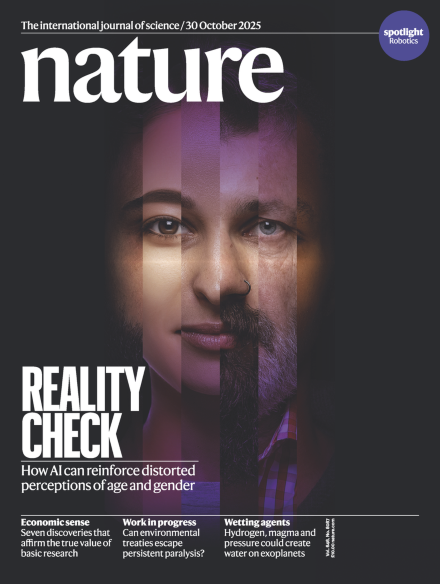
Nature tidbits [30th October 2025]

Posted in Books, Kids, pictures, Running, Travel, University life with tags , , , , , , , , , , , , , , , , , , , , , , , , , , , , , on November 22, 2025 by xi'an

In this October issue of nature, items of interest (to me) [already highlighted in an emailed News Highlight]:

Google claim a significant ‘quantum advantage’ by quantum-echoes algorithms that they say is 13,000 faster than classical algorithms, but it is unclear from the nature article where and when their algorithms can be used, apparently missing to apply to realistic scientific applications… (Along with a paper on an “atom-array architecture that enables continuous operation with reloading rates of up to 30,000 initialized qubits per second while preserving coherence across a rearranged large-scale qubit array”.)

On the Trump vs. Science scene, a predicted drop in PhD admissions as an adaptation to (uncertain) Trump’s cuts, bans, visa restrictions, and other attempts at arm-bending and blackmailing  (And the novelty of me receiving applications from the US, a first!) Some U.S. departments have simply cancelled PhD admissions… But some universities have so far resisted the Orange pressure. Namely, the MIT, Brown University, (good old) Penn, UCLA, the University of Virginia (albeit agreeing to a deal), Dartmouth College, and the University of Arizona in Tucson. Vanderbilt has given in. (UT Austin and Harvard seem to be continuing the discussion with the Trump administration.) Meanwhile, China is zooming past! The issue also contains articles on how fundamental science discoveries have had hugely practical consequences, in case one need argue with a sceptic.

As a less urgent issue, some researchers at Institut Pasteur in Paris identified new diseases that did not help Napoléon’s Grande Armée as it retreated from Moscow, from the DNA of 13 soldiers buried in Lithuania. (With nature failing to give credit to the painter Adolph Northen for his famous “Napoleon’s retreat from Moscow” illustrating the story, attributed to the researchers in the paper!)

In this period of ERC announcements of their grantees, an analysis of the two-digit rise in applications. Unsurprising, given the international context. Along with a decrease in funding due to a lack of adjustment against inflation since 2007. (Incidentally, I found out this week that Torsten Elßin—at the Max Planck Institute for Astrophysics—I visited once had been selected for a Synergy grant on a 3D Milky Way Atlas. Along another cosmology Synergy grant at MPA on the Epoch of Reionization.)

A runner’s must-read that starts with the statement “the human body has a ‘metabolic ceiling’ that even the most extreme athletes cannot surpass”. Which would be 2.4 times the basal metabolic rate (BMR) for extended periods—by which the authors mean 30 weeks and over!, not a half-marathon. Not so exciting a paper in the end.

As predicted by the cover, a Royal Society meeting acknowledging the AI language models killed Turing’ test and questioning the next one. Since assessing the capacities and limitations of novel AIs and AGIs sounds more relevant and societally important. To wit, “;the Turing test of the future should question whether an AI is safe, reliable and provides meaningful benefit, he said, and should also ask who bears the cost of that benefit”. (As discussed in the book review of The Means of Prediction: How AI Really Works (and Who Benefits) by Maximilian Kasy, in the same volume. And yet another paper on AI biases.)

human acts (book review)

Posted in Books, Kids, Travel with tags , , , , , , , , , , , , , , , , on October 3, 2025 by xi'an

After reading Han Kang’s The Vegetarian, I downloaded Human Acts which I found utterly impressive, hence the separate book review. This book gives connected snapshots of the democratisation uprising that happened in May 1980 in Gwangju, Korea, protesting a coup d’état, and of the savage repression that followed. With up to 2000 victims. (I was in my first year at the university at the time and cannot remember the news reaching me, despite being politically active, maybe because this was the year of the US Embassy take-over in Tehran and of the boycott of the Moscow Olympics.) The book is organised around the deaths of neighbours and the impact on their relatives until now. The style is strongly original, with bouts of magical realism like the thoughts of a cadaver inside a pile of corpses gathered by the military forces. The stories are all written from a character’s viewpoint, expressing her or his reasoning for joining the uprising and facing a probable death. I found these texts remarkable and highly moving in producing reconstituted motivations from “everyday” people, with no political agenda but an raw urge to recover democracy after decades of dictature. The original title is A boy comes (소년이 온다), which refers to the initial(isation) story, but the later Human Acts title seems quite appropriate, with its many interpretations and the stress on humanity, despite the horror of the repression.

scalable Monte Carlo for Bayesian learning [book review]

Posted in Books, Statistics, University life with tags , , , , , , , , , , , , , , , , , , , , on September 26, 2025 by xi'an

This book by Paul Fearnhead, Christopher Nemeth, Chris Oates, and Chris Sherlock is part of the IMS Monograph series. And published by Cambridge University Press. It covers most recent developments in MCMC methods, namely stochastic gradient MCMC (Chap. 3), non-reversible MCMC (Chap. 4), continuous-time MCMC (Chap. 5), and assessing and improving MCMC (Chap. 6). I find the book remarkable in its attention to rigour and clarity, without falling into overly technical derivations. It is perfectly suited for a graduate course to students with a solid mathematical background. In short, had I considered a new edition of our Monte Carlo Statistical Methods book to incorporate these advances, I could not done such a good job!

The first chapter provides a quick refresher of the background, from Monte Carlo principles, to Markov chains, SDEs, and the kernel “trick” (which requires a dozen pages of exposition). Nonetheless, it contains side remarks of true interest, including some suggestions I had not previously seen, as for instance an unusual introduction of the HMC algorithm as an underdamped Langevin diffusion. Chapter 2 prolongates this recap by covering reversible MCMC algorithms and the attached optimal scalings. This is done in a particularly friendly presentation that I intend to use in my own course. The HMC section is probably the best coverage I have seen on the topic, including most naturally the leapfrog steps.

Chapter 3 gets into stochastic gradient MCMC as an approximate MCMC, with nice arguments and formal convergence bounds. Again quite efficiently, if focussing almost solely on Gaussian settings (but including a neural network example). Similarly, Chapter 4 provides intuitive (if informal) arguments on the worth of non-reversible algorithms that are well-suited to a textbook of this level. This chapter introduces a PDMP sampler like the discrete bouncy particle sampler.

Chapter 5 is a (nicely) monstrous coverage of continuous time MCMC samplers that reaches very recent advances on PDMPs. The focus is on expressing them as limits, in order to derive mixing rates without extreme mathematical steps. (The chapter even includes a mention to the coordinate sampler that my PhD student Wu Changye derived in 2018!) Again a chapter I plan to use when teaching MCM methods, if possibly skipping some of the 66 pages.

Chapter 6 completes the monograph with a presentation of convergence assessment tools and diagnostics, exploiting the kernel trick, as well as convergence bounds that reflect very recent research in that domain. The conclusive section on optimal weights and optimal thinning will presumably be new to most readers. (Making me wonder if a link can be found with our importance Markov chain construct.)

[Disclaimer about potential self-plagiarism as usual: this post or an edited version will eventually appear in my Books Review section in CHANCE.]

a passage to India [book review]

Posted in Books, Mountains, pictures, Travel with tags , , , , , , , , , , , , , , on July 16, 2025 by xi'an

Feeling I had missed a classic of English literature and curious to see Forster’s views on colonial India, I started this book on a plane to India and finished it before I returned. The writing style is excellent, the characters are complex and, for the most multifaceted, the setting is inspired by Forster’s visits to India and hence realistic, the story timeline is well-set, for the most (ie except for the last part), and the scenario is engaging and realistic, but, obviously, what makes the book a masterpiece is its depiction of the British Raj from many perspectives, from British enforcers of its colonialism to British critics of said colonialism, to Indians trained in Britain, to completely local Indians, with the clash of multiple cultures and religions. Victorian prudery mixes with racial prejudices, resentment against discriminations leads to early (?) germs of fighting for independence, and the characteristic reaction of such a discriminatory and racist society to a claim of sexual impropriety on a British woman from a native man. This central event of the book is brought in both very subtly and unexpectedly (for those like me who had no initial idea of the story), with an equally subtle uncertainty about what really happened that remains till the end. If anything, the book may be delivering a pessimistic message on the impossible friendship between individuals from the ruling and oppressed groups, despite it being scandalous at the time for even suggesting such a friendship was conceivable. (The attached cover of the Penguin Classic edition is amazingly close to the excursion episode!)