Here are two exercises I wrote for my R mid-term exam in Paris-Dauphine around Buffon’s needle problem. In the end, the problems sounded too long and too hard for my 3rd year students so I opted for softer questions. So recycle those if you wish (but do not ask for solutions!)
Archive for Buffon’s needle
Buffon needled R exams
Posted in Books, Kids, R, Statistics, University life with tags Buffon's needle, Introduction to Monte Carlo Methods with R, mid-term exams, Paris, R, R exam, simulation, Université Paris Dauphine on November 25, 2013 by xi'ancannonball approximation to pi
Posted in Statistics with tags Buffon's needle, computer language, high school mathematics, Monte Carlo methods, programmation, R on October 8, 2011 by xi'anThis year, my daughter started writing algorithms in her math class (she is in seconde, which could correspond to the 10th grade). The one she had to write down last weekend was Buffon’s neddle and the approximation of π by Monte Carlo (throwing cannon balls was not mentioned!). Here is the short R code I later wrote to show her the outcome (as the class has not yet learned a computer language):
[sourcecode language=”r” gutter=”false”]
n=10^6
counter=0
#uniforms over the unit square
ray=runif(n)^2+runif(n)^2
#proportion within the quarter circle
conv=cumsum((ray<1))/(1:n)
plot(conv,type="l",col="steelblue",ylim=c(pi/4-2/sqrt(n),
pi/4+2/sqrt(n)),xlab="n",ylab="proportion")
abline(h=pi/4,col="gold3")
[/sourcecode]
and here is an outcome of the convergence of the approximation to π/4:
Buffon versus Bertrand in R
Posted in R, Statistics with tags Bertrand's paradox, Buffon's needle, R, sigma-algebra on April 8, 2011 by xi'an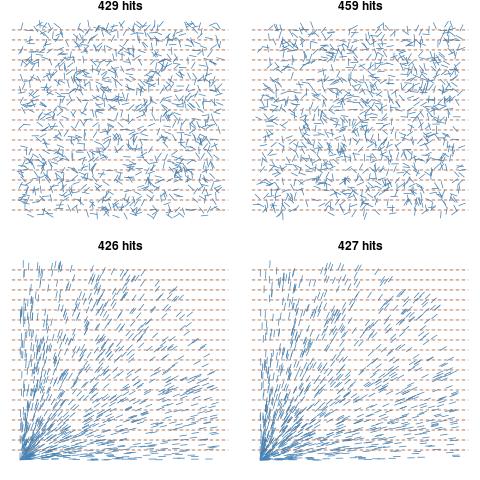 Following my earlier post on Buffon’s needle and Bertrand’s paradox, above are four outcomes corresponding to four different generations (among many) of the needle locations. The upper right-hand side makes a difference in the number of hits (out of 1000). The R code corresponding to this generation was made in the métro, so do not expect subtlety: Continue reading
When Buffon meets Bertrand
Posted in R, Statistics, Travel with tags Bertrand's paradox, Buffon's needle, Durham university, Julian Besag, Peter Diggle, Von Mises on April 7, 2011 by xi'an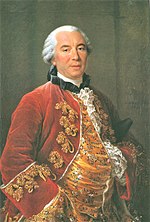 When Peter Diggle gave his “short history” of spatial statistics this morning (I typed this in the taxi from Charles de Gaulle airport, after waiting one hour for my bag!), he started with a nice slide about Buffon’s needle (and Buffon’s portrait), since Julian Besag was often prone to give this problem as a final exam to Durham students (one of whom is responsible for the candidate’s formula). This started me thinking about how this was open to a Bertrand’s paradox of its own. Indeed, randomness for the needle throw can be represented in many ways:
- needle centre uniformly distributed over the room (or the perpendicular to the boards) with a random orientation (with a provision to have the needle fit);
- needle endpoint uniformly distributed over the room (again a uniform over the perpendicular is enough) with a random orientation (again with a constraint);
- random orientation from one corner of the room and a uniform location of the centre on the resulting line (with constraints on both ends for the needle to fit);
- random orientation from one corner of the room and a uniform location of one endpoint on the resulting line, plus a Bernoulli generation to decide on the orientation (with constraints on both ends for the needle to fit);
- &tc.
I did not have time to implement those different generation mechanisms in R, but have little doubt they should lead to different probabilities of intersection between the needle and one of the board separations. I actually found a web-page at the University of Alabama Huntsville addressing this problem through exercises (plus 20,000 related entries! Including von Mises‘ Probability, Statistics and Truth itself. A book I should read one of those days, following Andrew.). Note that each version corresponds to a physical mechanism. Thus that there is no way to distinguish between them. Had I time, I would also like to consider the limiting case when the room gets infinite as, presumably, some of those proposals would end up being identical.


