Archive for China

Nature tidbits [06 Nov 2025]

Posted in Books, Kids, pictures, Travel with tags , , , , , , , , , , , , , , , , , , , , , , , , , , , , , , , , , , , , , , , , , , on January 3, 2026 by xi'an

In this issue of Nature (I read on my way to Warwick), a pre-COP30 tribune, to be opposed to later issues!, with a positive take on the impact of the Trump Administration ignoring the conference, with the advances made by China and India (with a surprising 50% of “installed electricity generation capacity coming from non-fossil sources”, if more critical on Brazil’s efforts than the subsequent tribune by the Brazilian undersecretary for ecological transformation for environment, plus a tribune on the ambiguous terms used by countries to secure access to “critical” minerals, in tune with the on-going muscle-flexing attitudes of China and the US. Although the comment is more focussing on the universal access to minerals than to the protection of the workers extracting it and to the environmental impact of it. Followed though by another comment on the climate impact(s) on mining as (no longer) extreme weather events hinder mining all over the (mining) world.

A reflection on China’s 5y plan for science and its reaching a $500 billion annual investment in R&D, predicting (with a large confidence margin) that it will become the #1 power in sciences and technology in the coming decade. I am actually surprised that China has not yet achieved this goal for semi-conductors. And a tribune on the mixed signal of Takaichi Sanae becoming Japan’s first female prime minister, for science as a whole and for gender equity. (My take being that her having UK’s first female prime minister, Margaret Thatcher, as a role-model is not particularly promising. Just like the projection of Marine Le Pen on the verge of becoming France’s first female president does not carry any optimistic message!)

A light entry on a chemical analysis of the specifics of koti luwak (or civet coffee) that does not tell much, beside civet  digestion  adding caprylic and capric acids making beans lower in proteïns and higher in fat. Not yet reaching the goal of “leaving the animals out” from producing this luxury coffee ($75 a cup!).

An article on the shrinking number of US PhD admissions (in some colleges) conflicting with another article in a later issue of a stable influx. And a rather shallow article on the creativity or lack thereof of AI, along with the high sycophancy of LLMs,  to be opposed to a thoughtful reflection on how AI is radically changing the PhD experience and focus, if almost shelving statistics as a thing from the past! But insisting on graduates keeping their ability to check for the validity of their (AI’s)  statistical conclusions!! And another entry on the systematic dismantling of US federal scientific agencies like EPA, CDC, NASA, NOOA, NIH, &tc., by Trump -2.0, which beyond terminating staff contracts in huge proportions is culling the independence of these agencies. With generational impacts on science, training, and evidence-based policies.

A Where I work column featuring a pangolin treated by a Singapore vet, Charlene Yeong. (Unfortunately said pangolin was euthanised after the surgical intervention.) And a book review on the background and motivations of Francis Crick,  just prior to his collaborator James Watson passing away. As noted by the author, Cobb, as MRC staff and later non-resident fellow of the Salk Institute for Biological Studies in San Diego,  “Crick never had to teach or grapple with university administration: he applied for a grant only once in his life.” And concludes that he was not a saint or a hero but “an extraordinarily clever man with limits to his interests and perception”.

renewable energy [book review]

Posted in Books, Kids, Travel with tags , , , , , , , , , , , , , , , , , , , , , , , , , , , , , on December 28, 2025 by xi'an

Renewable Energy (2nd edition, 2025), by Nick Jelley is part of the terrific “Very Short Introduction” series, which provides an expert introduction to a topic within 150 pages. (The OUP equivalent of the French series “Que sais-je?” that started in 1941.) The reason for the second edition, as provided by the author, is the “dramatic expansion, and fall in cost” of clean energy products. Unfortunately, it comes out just short of realising the magnitude of the backlash again renewable energy and fighting climate change launched by the second Trump administration and the ensuing added pressure on other countries to reduce further their fuel consumption.

The main sources of renewables are identified as wind, sun, and water, in a first chapter that operates as an historical recap on the evolution of energy sources and consumption. The second chapter stresses the need for renewable to fight global warming and to reverse climate change, with a rather vague discussion of the costs of producing energy from renewable. Chapter 3 focusses on (debatable) biomass, solar heat, and hydropower. Chapter 4 on wind power, with a few paragraphs on the production costs and the reluctance of local populations (that seems to be fuelled by right-wing parties). Chapter 5 is specifically about solar photovoltaïcs, deemed to be now cheaper than fossil fuels inmost countries. And substituting for deficient or inexistent large scale energy grids in some countries. And Chapter 6 deals (briefly) with other low-carbon technologies, like tidal dams (mentioning the 1966 La Rance dam near Mont Saint-Michel, Normandy, we would visit now and then when I was a kid!), wave turbines, nuclear energy, and geothermal power (both heating and providing electricity). Chapter 7 discusses renewable electricity issues with energy storage (batteries and pumped hydro storage), since most solutions cannot be fired at will. The book  addresses neither the loss in carrying electricity over long distances (as suggested p103 between Morocco and Europe, or Australia and Singapore), nor the hacking risks impacting large electricity grids. Chapter 8 switches to decarbonasing heat and transport, where heat pumps and electric vehicles are the most promising venues. Chapter 9 concludes by a more political discussion of the transition to renewable, pointing out the Chinese leadership in switching to solar and wind capacities. And the brake put on the transition by international crisis such as the Russian invasion of Ukraine that keep subsidies on fuel consumption. And make European countries divesting from this transition to invest in military budgets.

While the book manages a proper introduction to renewable energy and stays up-to-date with the current developments, I find it a bit overly optimistic on the prospect of achieving COP goals and carbon neutrality. Beyond the geostrategic issues briefly mentioned in the concluding chapter, there is no mention made of the exploding energy consumption of AIs and of the limited investments of AI companies into renewable energies… Reducing energy demand does not even occupy one page of the book (p127). Similarly, I find too little discussion of the political and human aspects of using renewables, eg photovoltaïcs and batteries, which resurfaced in the recent Chinese blockade on rare earths or coverages (as in Nature, 04 Nov 2025) on the extreme hardship of extracting minerals. Contrary to those (aspects) for massive dams affecting the local populations and in the dispute between countries or States. And also little on the environmental costs of producing and recycling both solar and wind farms, in contrast with hydroelectricity. Surprisingly, nuclear energy is evacuated in one paragraph in Chapter 2, on safety arguments. If reappearing in Chapter 6 with further concerns about the overall cost of nuclear energy.

[The usual disclaimer applies, namely that this bicephalic review is likely to appear later in CHANCE, in my book reviews column.]

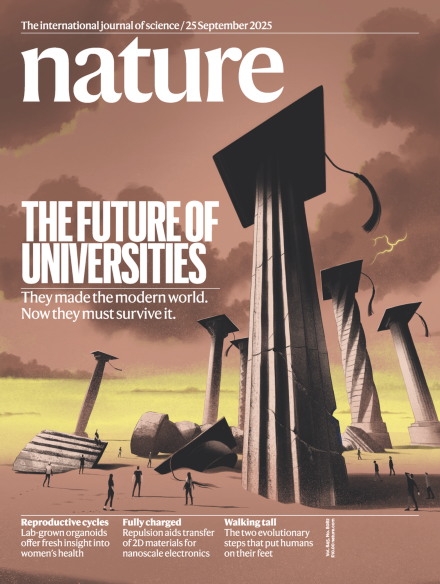
Nature tidbits [25 Sept 2025]

Posted in Books, Kids, University life with tags , , , , , , , , , , , , , on October 29, 2025 by xi'an

This (rather special) issue of Nature has several articles (in the general public section) about the massive changes impacting universities, worldwide, and the need for a paradigm shift. With a terrible if dedicated cover. On the one hand, the explosion of student populations and the prevalence of online technologies make the medieval approach of lecturing to mostly passive audiences highly inefficient. Witness this recent article from the NYT on Harvard students not attending lectures and failing to read the material. On the other hand, the funding of higher education institutions is shifting away from State support to alternative sources, first and foremost by increasing students’ fees and resorting to private organizations. Incl. a supposedly socialist State like China. The scholarly traditions of free speech and open-minded debate—which in truth remained restricted for most of their existence, witness the repeated heresy accusations in the dark ages!—are under threat, for both internal and external reasons, here and there. The benefits of higher education trainings are also shrinking, unsurprisingly when most of an age group reaches master level degrees, and the quality of said training is getting more and more heterogeneous. The issue also points out the fast moving dynamics of studies abroad, with a high portion of candidates to foreign studies, able to shift destinations for multifactorial reasons (and not only Orange ones). Witness the drop in foreign students joining UK universities and the resulting crisis on their financing. The paper follows a UK experiment going the other way, the NMITE in Hererford, midway between B’ham and Cardiff, where a lab based engineering training is taking place, “the sector nationally that’s been most vociferously complaining about the quality and work readiness of the graduates the traditional sector produces”. In collaboration with local companies, which obviously makes sense but also raises concerns (not voiced by Nature) on the long-term benefits of the approach, when the skills leant to fill understaffed jobs will no longer be required. I thus find paradoxal that the article adheres to the claim that practical teaching makes for more flexible graduates, compared with hardcore courses that provide methods and principles… Unless the flexibility is solely in terms of employability. This coverage is nonetheless a realistic experiment better than the call for better training in a front page tribune that shows little practicality. Apart from this concern, reports on AIs reviewing grant applications and the Trump administration disbanding its climate panel after endorsing their terrible report. Plus unsurprising articles on plant-based diet improving diabetes risk and physical exercise colon cancer survival.

the Harvard and Brown school of computer science

Posted in Books, Statistics, Travel, University life with tags , , , , , , , , , , , , , , , , , , , , , , , , , , , , , , on October 2, 2025 by xi'an

 “In the late 1980s, LeCun, then a researcher at AT&T Bell Labs, developed a powerful neural network that learned to recognise handwritten zip codes by training on thousands of examples. A parallel development soon unfolded at Harvard and Brown. In 1995, Zhu and a team of researchers there started developing probability-based methods that could learn to recognise patterns and textures (…) and even generate new examples of that pattern. These were not neural networks: members of the “Harvard-Brown school”, as Zhu called his team, cast vision as a problem of statistics and relied on methods such as “Bayesian inference” and “Markov random fields”. The two schools spoke different mathematical languages and had philosophical disagreements. But they shared an underlying logic – that data, rather than hand-coded instructions, could supply the infrastructure for machines to grasp the world and reproduce its patterns – that exists in today’s AI systems such as ChatGPT.” 

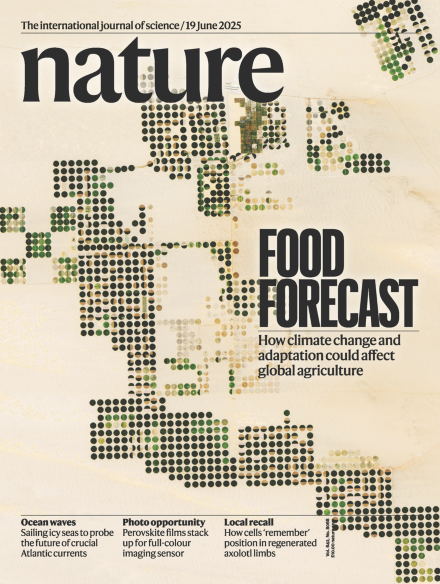
Nature tidbits [19 June 2025]

Posted in Books, Kids, pictures, Travel, University life with tags , , , , , , , , , , , , , , , , , , , , , , , , , , , , , , , , , , , , , , , , , , on August 9, 2025 by xi'an

Editorials on China becoming the World scientific superpower, along with a call for continued collaboration under security risk assessment, the news that all incoming Nature publications will come accompanied by the full editorial process (reviews and authors’ responses), which sounds most sensible to me, another call for novel research indicators to be used eg in the REF but… being co-funded by Elsevier is not especially promising!—along with a Nature investigation on paper mills—, and another personal take calling for new FAA models on air controller loads, which are too light according to the author!, who thinks controllers can handle several flights concurrently.

News on the incoming Vera Rubin Observatory telescope in Chile—if not close to the Atacama peaks I climbed during ISBA 2004—and its unique technology (with a camera the size of a car!). As well as a highlight on African space agencies (where I discovered that Egypt is the most active). Plus, a rather vague report on ether0 as a “stepping stone towards a reasoning model“,  once again playing with words and double meaning on what’s reason(ing). Further entries (alas!) onH ow Trump 2.0 is reshaping science with the impact of barring entry to 19 countries’ nationals and China multiplying calls to attract researchers from abroad and keep students in the country. Including unusually large salaries and benefits. (Pangolins and axolotls make an appearance in both this issue and the next, how unlikely is this?! With the conflicting items of information that the former are primarily hunted for their scales or for their taste.)

The most frightening section of the 19 June issue is however on the threat of a collapse of the Atlantic Meridional Overturning Circulation (AMOC), which would bring a new Ice Age to Western Europe and dramatic changes in the weather worldwide. Along with several research articles on climate change and its impacts.