Archive for China

Tea days

Posted in Mountains, pictures, Travel, Wines with tags , , , , , , , , , , , , , , , , , , on May 23, 2025 by xi'an

And on the same day I came upon the announcement that Indian Railways was trying to revive a switch from plastic cups to the traditional kulhads (clay cups) in trains and train stations. Which is presumably another still-born attempt at greenwashing, given the logistical challenges of procuring clay to village potters, producing millions of kulhads every day, delivering and storing unstandardised cups, and figuring out how to recycle them. Not mentioning that firing and carrying these cups also has an ecological impact. Better start a campaign of bring-your-own-cup (which I tried to impose for a few conferences, mostly unsuccessfully!)

Data science ethics [book review]

Posted in Books, Statistics, University life with tags , , , , , , , , , , , , , , , , , , , , , , , , , , , , , , , , , on May 5, 2025 by xi'an

Data science ethics (concepts, techniques and cautionary tales), by David Martens, was published in 2022 by Oxford University Press. The book is inspired by the author’s  course on Data Science and ethics he has been teaching at the University of Antwerp. (With a link to his slides.) The 255p book proceeds by decomposing the ethics of data science into its different steps: data gathering (Chap. 2), data preprocessing (Chap. 3), modelling (Chap. 4), evaluation (Chap. 5), and deployment (Chap. 6). Following the `FAT Flow Framework´, where FAT stands for fairness, accountability, and transparency.

Do not expect much maths, stats, or anything quantitative: this book is mostly about concepts, even though some (mostly well-known) illustrations are provided. Chapter 2 includes a description of encryption (with homomorphic encryption treated in Chapter 4). And somewhat improbably quantum computing. Differential privacy gets a few pages with not a single formula (until Chapter 4, again).

Chapter 3 covers k-anonymity, record linkage, reidentification, (through cautionary tales) and discrimination through biases in the (learning) dataset.  Chapter 4 is defining ε differential privacy with the Laplace randomization as a possible implementation and with no critical stance on the limitations of the concept. The computation limitations of homomorphic encryption are more clearly pointed out. Federated learning is only quickly mentioned. The section about measuring fairness and reducing bias implies that some prior knowledge is available about whom is potentially discriminated and which covariates to add to the model. The last section on explicability of predictions is worthwhile in signalling the difficulty with most (black box) AI but the example opposing an SVM model to a logistic model is not tremendously convincing in that neither model is true.

Chapter 5 addresses the crucial challenge of ethical evaluation in a rather verbose and vague manner. For instance, with no instruction on how to resist adversarial attacks. Or criticising p-hacking and multiple testing while missing the elephant in the room (p-values!). Drifting from the topic when discussing the misdeeds of Diederik Stapel. Most of the same goes about Chapter 6 and its take on ethical deployment, when going through examples such as Google’s policies in China. Or general musing on the impact of AI on societal inequalities (with mentions of companies and CEOs who have since then back-pedalled on their ethical engagement). These chapters are lacking in tools and (more) practical recommendations.

One interesting aspect of the book is the attention paid to the EU(ropean) aspect of these concerns, through the GDPR (General DAta Protection Regulations) adopted by the European Parliament in 2016. (There is also a brief mention of China’s regulations, but no details beyond a reference. Maybe the Chinese edition differs.)

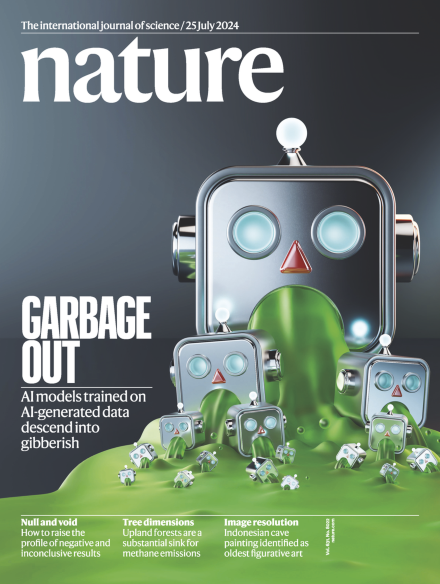
Nature tidbits [and garbage out]

Posted in Books, Kids, Mountains, pictures, Travel, University life with tags , , , , , , , , , , , , , , , , , , , , , , , , , on October 25, 2024 by xi'an

Many bits of interest in the 25 July issue of Nature that stayed under a pile of journals for PNW reasons! Even though the cover is rather off-putting…

  • A call by the editors (and computer scientist Cal Newport) for scientists to “stop, drop, and think” (and the paperback version of Newport’s Slow Productivity has a nice cover that looks very much like Moraine Lake in Banff National Parc!)
  • Another call by a Science Po’ sociologist to the (then highly prospective) French government to increase research budget for French universities, which is not particularly original since this is a constant line on all unions’ desiderata, except for the argument that it would make a tuition fees increase more palatable, and to leave more freedom to researchers, with the oft-used argument that “fundamental research may have unexpected implications”. Except that a massive public deficit is going to impose budget squeezes in all spending lines of the Barnier government.
  • Worries of Indian and non-Indian demographers about the continued postponement of India’s national census, with the latest one dating from 2011. With strong repercussions on public policies, especially since the administrative data systems are rarely reliable. The article suggests that more than an estimated 100 million inhabitants are excluded from food subsidies as a consequence. This seems like an opportunity to develop open source alternatives that run the census from indirect observations, bypassing the reluctance of the Modi Government to launch the much delayed census. (Which could have been coupled with the electoral process earlier this year.)
  • An insight on four female “PhD influencers” from the Universities of Pennsylvania, Exeter, Hertfordshire, and Hong Kong (CUHK). Which has a plus side of exposing the life and interests of a PhD student. And a downside of being a social media product, with the many biases that come along posting to the general public.
  • A call for publishing more papers about negative results! Supporting (pre)registration of experiments.
  • A positive book review of The MANIAC of Benjamin Labatut around John von Neumann’s life, analysed by Karl Sigmund
  • A four-page long comment on the importance of preserving scientific US-China relations, despite the growing suspicion in the US that any scientific collaboration with Chinese institutions will benefit Chinese (State) interests. Without falling for a naive approach to such collaborations, and acknowledging the porous boundaries between fundamental and military research, one should acknowledge the great leap forward accomplished by Chinese universities in the past decade that set their researchers at the forefront of science in many fields.
  • A paper related with the cover on model collapse in AIs learning from AI-generated data. Just like MCMC learning a proposal from earlier simulations. A natural consequence of over-fitting.
  • Another paper on the phase (or quantum) transition of the two-dimensional Ising spin glass (model).
  • and the article on predatory conferences I already discussed in August.

Nature snapshots

Posted in Books with tags , , , , , , , , , , , , , , , , , , , , , , , on September 5, 2024 by xi'an

Some quick breakfast reads from the 11 July issue of Nature (the one with the frog cover!),

  • A tribune on the Canadian example of advocating for graduate and postdoc pay raises, with a success last April. It would prove difficult to achieve in a French academic landscape when postdocs here earn about as much as starting lecturers, whose salary is notoriously low.
  • A news article on the UK elections Labour landslide impact on national scientific landscape, with the former Conservatives’ government Chief Adviser and former Head of Research at GlaxoSmithKline and governmental speaker during the COVID crisis appointed as science minister (how many countries enjoy a science ministry?!) But Labour has shown no inclination to back up (from the former stance) on EU collaborations (no Erasmus!), restrictions on students visa that induced a 40% drop in overseas enrolments, or funding of UK universities (whose finances are in a terrible state). Followed by a call from five UK researchers to “give UK science the overhaul it urgently needs¨.
  • A paper about identifying brain cells attached to a word’s meaning (with an example opposing son and Sun that reminded me of the confusion I had with the Taïwanese movie A Sun!)
  • An another paper on an analysis of January 2020 data collected in the Huanan seafood market in Wuhan, with three virus identified. But inconclusive about the origin of the virus.
  • A work column on the challenges of conservation ecology, with trade-offs between intervention and inaction for endangered species (with the nugget of information that Ecuador gives nature constitutional rights).
  • And a back page on the TIGRR lab [great acronym!] in Melbourne attempt at resurrecting the extinct thyalacine (or Tasmanian tiger) from historical specimens, not mentioning the involvement of a biotech company, Colossal Biosciences, also involved in recreating  mammoths. Which sounds counterproductive beyond the bioengineering feat, esp. with regard to the mammoths, which would be woolly (!) unsuited to the current World (except in some remote corner of Siberia?!) and its climate. When considering how challenging protecting the few remaining African elephants is, imaging free roaming mammoths that would not come to clash with human activities beggars belief.

a journal of the chaos, conquest, war, famine, and death year

Posted in Books, Kids, Mountains, pictures, Running, Travel with tags , , , , , , , , , , , , , , , , , , , , , , , , , , , , on June 15, 2024 by xi'an

Read R.F. Kuang’s Babel. (Or the Necessity of Violence: An Arcane History of the Oxford Translators’ Revolution.) With a nice (magical) premise, some forays into linguistics, but fairly lazy in sticking so much to actual 19th Century Victorian history despite the fantasy openings of this alternate history, and in over-(over-)indulging (as in many college-life novels) into the perks of college life at the University of Oxford, plus glaring coherence gaps in the story and in the character construction, along with a simplistic writing style. The last part is particularly painful (in its suspension of belief) and the “necessity of violence” quite readily embraced by the main characters, with poor ethical arguments. Which makes the 2022 Blackwell’s Book of the Year for Fiction Award and 2023 Nebula Award for Best Book of the Year somewhat of a surprise. (While her exclusion from the 2023 Hugo Award list as ineligible was both a scandal and an argument for not holding book awards in dictatures.)

Made Sonoran tortillas (half-wheat & half-rye) to handle a large batch of home made pulled pork, which lasted for an entire week meal-wise! Justifying the 2½ hours and 4 steps they require .

Watched The Gentlemen Netflix series, a British comedy which I found terribly cliché and prejudiced against disadvantaged social groups, e.g., Irish travellers or Mancunian working class gangsters, despite its advertised pretence at aiming primarily at the British aristocracy, “the original gangsters [with] William the Conqueror worse than Al Capone“. And increasingly boring since realism gets out of the window from the very beginning. Loads of potential references to spot though, like a Ian Rankin’s gangster citing the Bible or (very obviously) Lawrence’s Lady Chatterley’s lover.