Archive for Dirichlet mixture priors

parallelizable sampling method for parameter inference of large biochemical reaction models

Posted in Books, Statistics with tags , , , , , , , , on June 18, 2018 by xi'an

I came across this older (2016) arXiv paper by Jan Mikelson and Mustafa Khammash [antidated as of April 25, 2018] as another version of nested sampling. The novelty of the approach is in applying nested sampling for approximating the likelihood function in the case of involved hidden Markov models (although the name itself does not appear in the paper). This is an interesting proposal, even though there is a fairly large and very active literature on computational approaches to such objects, from sequential Monte Carlo (SMC) to particle MCMC (pMCMC), to SMC².

“We found a way to efficiently sample parameter vectors (particles) from the super level set of the likelihood (sets of particles with a likelihood equal to or higher than some threshold) corresponding to an increasing sequence of thresholds” (p.2)

The approach here is an aggregate of nested sampling and particle filters (SMC), filters that are paradoxically employed in approximating the likelihood function itself, thus called repeatedly as the value of the parameter θ changes, unless I am confused, when it seems to me that, once started with particle filters, the authors could have used them all the way to the upper level (through, again, SMC²). Instead, and that brings a further degree of (uncorrected) approximation to the procedure, a Dirichlet process prior is used to estimate Gaussian mixture approximations to the true posterior distribution(s) on the (super) level sets. Now, approximating a distribution that is zero outside a compact set [the prior restricted to the likelihood being larger than by a distribution with an infinite support does not a priori sound like a particularly enticing idea. Note also that there is no later correction for using the mixture approximation to the restricted prior. (The method also involves an approximation of the (Lebesgue) volume of the level sets that may be poor in higher dimensions.)

“DP-GMM estimations work very well in high dimensional spaces and since we use rejection sampling to obtain samples from the level set by sampling from the DP-GMM estimation, the estimation error does not get propagated through iterations.” (p.13)

One aspect of the paper that puzzles me is the use of a rejection sampler to produce new parameters simulations from a given (super) level set, as this involves a lower bound M on the Gaussian mixture approximation over this level set. If a Gaussian mixture approximation is available, there is apparently no need for this as it can be sampled directly and values below the threshold can be disposed of. It is also unclear why the error does not propagate from one level to the next, if only because of the connection between the successive particle approximations.


a Ca’Foscari [first Italian-French statistics seminar]

Posted in Kids, pictures, Statistics, Travel, University life with tags , , , , , , , , , , , , , on October 26, 2017 by xi'an

Apart from subjecting my [surprisingly large!] audience to three hours of ABC tutorial today, and after running Ponte della la Libertà to Mestre and back in a deep fog, I attended the second part of the 1st Italian-French statistics seminar at Ca’Foscari, Venetiarum Universitas, with talks by Stéfano Tonellato and Roberto Casarin. Stéfano discussed a most interesting if puzzling notion of clustering via Dirichlet process mixtures. Which indeed puzzles me for its dependence on the Dirichlet measure and on the potential for an unlimited number of clusters as the sample size increases. The method offers similarities with an approach from our 2000 JASA paper on running inference on mixtures without proper label switching, in that looking at pairs of allocated observations to clusters is revealing about the [true or pseudo-true] number of clusters. With divergence in using eigenvalues of Laplacians on similarity matrices. But because of the potential for the number of components to diverge I wonder at the robustness of the approach via non-parametric [Bayesian] modelling. Maybe my difficulty stands with the very notion of cluster, which I find poorly defined and mostly in the eyes of the beholder! And Roberto presented a recent work on SURE and VAR models, with a great graphical representation of the estimated connections between factors in a sparse graphical model.

repulsive mixtures

Posted in Books, Statistics with tags , , , , , , , , on April 10, 2017 by xi'an

Fangzheng Xie and Yanxun Xu arXived today a paper on Bayesian repulsive modelling for mixtures. Not that Bayesian modelling is repulsive in any psychological sense, but rather that the components of the mixture are repulsive one against another. The device towards this repulsiveness is to add a penalty term to the original prior such that close means are penalised. (In the spirit of the sugar loaf with water drops represented on the cover of Bayesian Choice that we used in our pinball sampler, repulsiveness being there on the particles of a simulated sample and not on components.) Which means a prior assumption that close covariance matrices are of lesser importance. An interrogation I have has is was why empty components are not excluded as well, but this does not make too much sense in the Dirichlet process formulation of the current paper. And in the finite mixture version the Dirichlet prior on the weights has coefficients less than one.

The paper establishes consistency results for such repulsive priors, both for estimating the distribution itself and the number of components, K, under a collection of assumptions on the distribution, prior, and repulsiveness factors. While I have no mathematical issue with such results, I always wonder at their relevance for a given finite sample from a finite mixture in that they give an impression that the number of components is a perfectly estimable quantity, which it is not (in my opinion!) because of the fluid nature of mixture components and therefore the inevitable impact of prior modelling. (As Larry Wasserman would pound in, mixtures like tequila are evil and should likewise be avoided!)

The implementation of this modelling goes through a “block-collapsed” Gibbs sampler that exploits the latent variable representation (as in our early mixture paper with Jean Diebolt). Which includes the Old Faithful data as an illustration (for which a submission of ours was recently rejected for using too old datasets). And use the logarithm of the conditional predictive ordinate as  an assessment tool, which is a posterior predictive estimated by MCMC, using the data a second time for the fit.

Monte Carlo in the convent

Posted in pictures, Statistics, Travel, University life with tags , , , , , , , , , on July 14, 2016 by xi'an

Last week, at the same time as the workshop on retrospective Monte Carlo in Warwick, there was a Monte Carlo conference in Paris, closing a Monte Carlo cycle run by Institut Louis Bachelier from October 2015 till June 2016. It took place in the convent of Les Cordeliers, downtown Paris [hence the title] and I alas could not attend the talks. As I organised a session on Bayesian (approximate) computations, with Richard Everitt, Jere Koskela, and Chris Sherlock as speakers (and Robin Ryder as chair), here are the slides of the speakers (actually, Jere most kindly agreed to give Chris’ talk as Chris was to sick to travel to Paris):

mixture models with a prior on the number of components

Posted in Books, Statistics, University life with tags , , , , , , , on March 6, 2015 by xi'an

mixdir

“From a Bayesian perspective, perhaps the most natural approach is to treat the numberof components like any other unknown parameter and put a prior on it.”

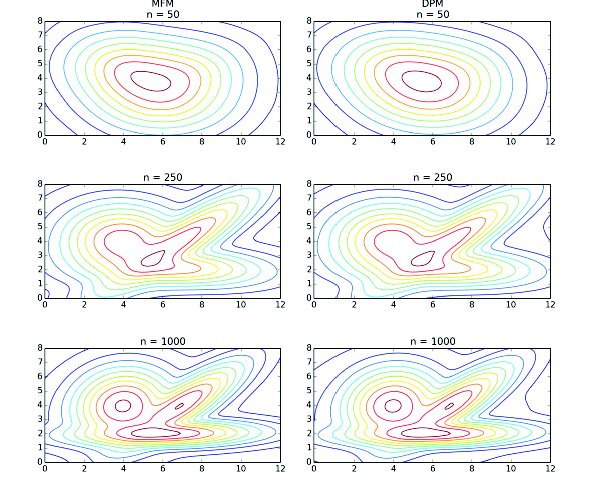
Another mixture paper on arXiv! Indeed, Jeffrey Miller and Matthew Harrison recently arXived a paper on estimating the number of components in a mixture model, comparing the parametric with the non-parametric Dirichlet prior approaches. Since priors can be chosen towards agreement between those. This is an obviously interesting issue, as they are often opposed in modelling debates. The above graph shows a crystal clear agreement between finite component mixture modelling and Dirichlet process modelling. The same happens for classification.  However, Dirichlet process priors do not return an estimate of the number of components, which may be considered a drawback if one considers this is an identifiable quantity in a mixture model… But the paper stresses that the number of estimated clusters under the Dirichlet process modelling tends to be larger than the number of components in the finite case. Hence that the Dirichlet process mixture modelling is not consistent in that respect, producing parasite extra clusters…

In the parametric modelling, the authors assume the same scale is used in all Dirichlet priors, that is, for all values of k, the number of components. Which means an incoherence when marginalising from k to (k-p) components. Mild incoherence, in fact, as the parameters of the different models do not have to share the same priors. And, as shown by Proposition 3.3 in the paper, this does not prevent coherence in the marginal distribution of the latent variables. The authors also draw a comparison between the distribution of the partition in the finite mixture case and the Chinese restaurant process associated with the partition in the infinite case. A further analogy is that the finite case allows for a stick breaking representation. A noteworthy difference between both modellings is about the size of the partitions

\mathbb{P}(s_1,\ldots,s_k)\propto\prod_{j=1}^k s_j^{-\gamma}\quad\text{versus}\quad\mathbb{P}(s_1,\ldots,s_k)\propto\prod_{j=1}^k s_j^{-1}

in the finite (homogeneous partitions) and infinite (extreme partitions) cases.

An interesting entry into the connections between “regular” mixture modelling and Dirichlet mixture models. Maybe not ultimately surprising given the past studies by Peter Green and Sylvia Richardson of both approaches (1997 in Series B and 2001 in JASA).