Archive for graduate course

Time series

Posted in Books, R, Statistics with tags , , , , , , on March 29, 2011 by xi'an

(This post got published on The Statistics Forum yesterday.)

The short book review section of the International Statistical Review sent me Raquel Prado’s and Mike West’s book, Time Series (Modeling, Computation, and Inference) to review. The current post is not about this specific book, but rather on why I am unsatisfied with the textbooks in this area (and correlatively why I am always reluctant to teach a graduate course on the topic). Again, I stress that the following is not specifically about the book by Raquel Prado and Mike West!

With the noticeable exception of Brockwell and Davis’ Time Series: Theory and Methods, most time-series books seem to suffer (in my opinion) from the same difficulty, which sums up as being unable to provide the reader with a coherent and logical description of/introduction to the field. (This echoes a complaint made by Håvard Rue a few weeks ago in Zurich.) Instead, time-series books appear to haphazardly pile up notions and techniques, theory and methods, without paying much attention to the coherency of the presentation. That’s how I was introduced to the field (even though it was by a fantastic teacher!) and the feeling has not left me since then. It may be due to the fact that the field stemmed partly from signal processing in engineering and partly from econometrics, but such presentations never achieve a Unitarian front on how to handle time-series. In particular, the opposition between the time domain and the frequency domain always escapes me. This is presumably due to my inability to see the relevance of the spectral approach, as harmonic regression simply appears (to me) as a special type of non-linear regression with sinusoidal regressors and with a well-defined likelihood that does not require Fourier frequencies nor periodogram (nor either spectral density estimation). Even within the time domain, I find the handling of stationarity  by time-series book to be mostly cavalier. Why stationarity is important is never addressed, which leads to the reader being left with the hard choice between imposing stationarity and not imposing stationarity. (My original feeling was to let the issue being decided by the data, but this is not possible!) Similarly, causality is often invoked as a reason to set constraints on MA coefficients, even though this resorts to a non-mathematical justification, namely preventing dependence on the future. I thus wonder if being an Unitarian (i.e. following a single logical process for analysing time-series data) is at all possible in the time-series world! E.g., in Bayesian Core, we processed AR, MA, ARMA models in a single perspective, conditioning on the initial values of the series and imposing all the usual constraints on the roots of the lag polynomials but this choice was far from perfectly justified…

R [re-]exam

Posted in Books, R, Statistics, University life with tags , , , , on March 28, 2011 by xi'an

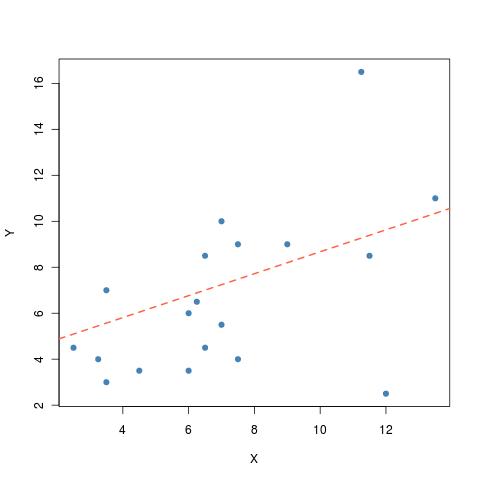
In what seems like an endless cuRse, I found this week I had to re-grade a dozen R exams a TA’s did not grade properly! The grades I (X) got are plotted below against those of my TA (Y). There is little connection between both gradings… As if this was not enough trouble, I also found exactly duplicated R codes in another R project around Introducing Monte Carlo methods with R that was returned a few weeks ago. Meaning I will have to draft a second round exam… (As Tom commented on an earlier post, team resolution of a given problem may be a positive attitude, but in the current case one student provided an A⁺⁺ answer, while two others clearly drafted an hasty resolution from the original.) Nonetheless, do not worry, I still love [teaching] R!

15 all-timers [back]

Posted in Statistics with tags , , , , , on November 26, 2010 by xi'an

Following an earlier post and poll. six of my graduate students took the Reading Classics seminar this year (plus two who dropped out). They chose

  1. W.K.Hastings (1970) Monte Carlo sampling methods using Markov chains and their applications, Biometrika
  2. G. Casella & W. Strawderman (1981) Estimation of a bounded mean Annals of Statistics
  3. A.P. Dawid, M. Stone & J. Zidek (1973) Marginalisation paradoxes in Bayesian and structural inference J. Royal Statistical Society
  4. C. Stein (1981) Estimation of the mean of a multivariate normal distribution Annals of Statistics
  5. D.V. Lindley & A.F.M. Smith (1972) Bayes Estimates for the Linear Model  J. Royal Statistical Society
  6. A. Birnbaum (1962) On the Foundations of Statistical Inference J. American Statistical Assoc.

in this order and mostly managed to grasp the quintessentials of the papers and to give decent (Beamer) presentations. The hardest one was the exposition of the likelihood principle and the student who chose this paper struggled to go past a mere repetition of the proofs. I enjoyed it nonetheless because the presentation raised questions about this principle,

Continue reading →

“Introducing Monte Carlo Methods with R” is out!

Posted in Books, R, Statistics with tags , , , , , , on December 10, 2009 by xi'an

That’s it!, “Introducing Monte Carlo Methods with R” is out, truly out, I have received a copy from Springer by express mail today! (If you need any further proof, it is also advertised as In stock by Amazon.) Given that the printer exactly reproduces the pdf file sent to Springer, there is no element of surprise as in my earliest book (where I found a particularly horrendous typo made by the French publisher on the back cover!) but it is nonetheless a very pleasant feeling to take (finally!) hold of one’s new book! Since there must be remaining typos and even more obscure points, feel free to contact George Casella or myself for corrections and precisions.

Mathematics looking for mathematicians

Posted in Statistics, University life with tags , , , on December 6, 2009 by xi'an

This is on the cover of Le Monde today! In association with the workshop “Maths à venir“, i.e. “Maths to come”, jointly supported by the Société Mathématique de France, the Société Francaise de Statistique and the Société de Mathématiques Appliquées et Industrielles, there were several newshots in Mathematics this week on the national chanels, including a roundtable on the national public radio France Inter (with Jean-Pierre Bourguignon and the statistician Claudine Schwartz, also signing as C. Robert!) and this piece is an illustration of the efforts of the mathematicians. to reach the medias… The decrease in the number of math (and science) students in universities is a global trend in Western countries and France is not spared by this phenomenon. Till very recently, mathematical finance graduate programs were able to partly compensate for this decline but the subprime crisis has also impacted this flow. While the paper argues that the crisis has degraded the image of mathematics among students, I am quite skeptical about this, because financial mathematics are only taught in the final year of graduate programs. My own observation is that the last year saw instead a surge in the number of PHD students in mathematics (and statistics) as a result of lesser positions in banks and companies.