“We now think the Bayesian Programming methodology and tools are reaching maturity. The goal of this book is to present them so that anyone is able to use them. We will, of course, continue to improve tools and develop new models. However, pursuing the idea that probability is an alternative to Boolean logic, we now have a new important research objective, which is to design specific hsrdware, inspired from biology, to build a Bayesian computer.”(p.xviii)
 On the plane to and from Montpellier, I took an extended look at Bayesian Programming a CRC Press book recently written by Pierre Bessière, Emmanuel Mazer, Juan-Manuel Ahuactzin, and Kamel Mekhnacha. (Very nice picture of a fishing net on the cover, by the way!) Despite the initial excitement at seeing a book which final goal was to achieve a Bayesian computer, as demonstrated by the above quote, I however soon found the book too arid to read due to its highly formalised presentation… The contents are clear indications that the approach is useful as they illustrate the use of Bayesian programming in different decision-making settings, including a collection of Python codes, so it brings an answer to the what but it somehow misses the how in that the construction of the priors and the derivation of the posteriors is not explained in a way one could replicate.
“A modeling methodology is not sufficient to run Bayesian programs. We also require an efficient Bayesian inference engine to automate the probabilistic calculus. This assumes we have a collection of inference algorithms adapted and tuned to more or less specific models and a software architecture to combine them in a coherent and unique tool.” (p.9)
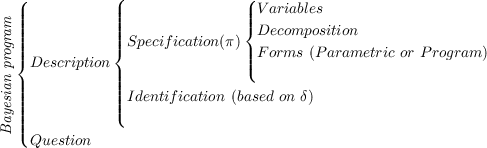
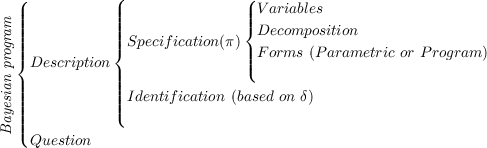
For instance, all models therein are described via the curly brace formalism summarised by
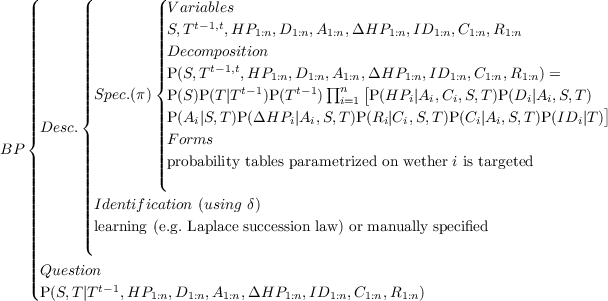
 which quickly turns into an unpalatable object, as in this example taken from the online PhD thesis of Gabriel Synnaeve (where he applied Bayesian programming principles to a MMORPG called StarCraft and developed an AI (or bot) able to play BroodwarBotQ)
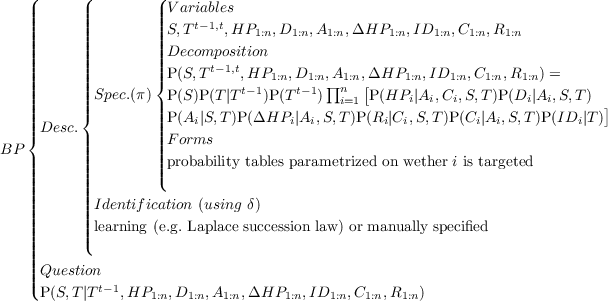 thesis that I found most interesting!
“Consequently, we have 21 × 16 = 336 bell-shaped distributions and we have 2 × 21 × 16 = 772 free parameters: 336 means and 336 standard deviations.¨(p.51)
Now, getting back to the topic of the book, I can see connections with statistical problems and models, and not only via the application of Bayes’ theorem, when the purpose (or Question) is to take a decision, for instance in a robotic action. I still remain puzzled by the purpose of the book, since it starts with very low expectations on the reader, but hurries past notions like Kalman filters and Metropolis-Hastings algorithms in a few paragraphs. I do not get some of the details, like this notion of a discretised Gaussian distribution (I eventually found the place where the 772 prior parameters are “learned” in a phase called “identification”.)
“Thanks to conditional independence the curse of dimensionality has been broken! What has been shown to be true here for the required memory space is also true for the complexity of inferences. Conditional independence is the principal tool to keep the calculation tractable. Tractability of Bayesian inference computation is of course a major concern as it has been proved NP-hard (Cooper, 1990).”(p.74)
The final chapters (Chap. 14 on “Bayesian inference algorithms revisited”, Chap. 15 on “Bayesian learning revisited” and Chap. 16 on “Frequently asked questions and frequently argued matters” [!]) are definitely those I found easiest to read and relate to. With mentions made of conjugate priors and of the EM algorithm as a (Bayes) classifier. The final chapter mentions BUGS, Hugin and… Stan! Plus a sequence of 23 PhD theses defended on Bayesian programming for robotics in the past 20 years. And explains the authors’ views on the difference between Bayesian programming and Bayesian networks (“any Bayesian network can be represented in the Bayesian programming formalism, but the opposite is not true”, p.316), between Bayesian programming and probabilistic programming (“we do not search to extend classical languages but rather to replace them by a new programming approach based on probability”, p.319), between Bayesian programming and Bayesian modelling (“Bayesian programming goes one step further”, p.317), with a further (self-)justification of why the book sticks to discrete variables, and further more philosophical sections referring to Jaynes and the principle of maximum entropy.
“The “objectivity” of the subjectivist approach then lies in the fact that two different subjects with same preliminary knowledge and same observations will inevitably reach the same conclusions.”(p.327)
Bayesian Programming thus provides a good snapshot of (or window on) what one can achieve in uncertain environment decision-making with Bayesian techniques. It shows a long-term reflection on those notions by Pierre Bessière, his colleagues and students. The topic is most likely too remote from my own interests for the above review to be complete. Therefore, if anyone is interested in reviewing any further this book for CHANCE, before I send the above to the journal, please contact me. (Usual provisions apply.)