 A question on X validated gave me minor thought fodder for my crisp pre-dawn run in Warwick the other week: if one wants to use importance sampling for a variable Y that has no closed form density, but can be expressed as the transform (marginal) of a vector of variables with closed form densities, then, for Monte Carlo approximations, the problem can be reformulated as the computation of an integral of a transform of the vector itself and the importance ratio is given by the ratio of the true density of the vector over the density of the simulated vector. No Jacobian involved.
Archive for Jacobian
importance demarginalising
Posted in Books, Kids, pictures, Running, Statistics, Travel, University life with tags cross validated, importance sampling, Jacobian, Monte Carlo Statistical Methods, University of Warwick, Warwickshire on November 27, 2017 by xi'anan elegant result on exponential spacings
Posted in Statistics with tags Book, change of variables, cross validated, exponential distribution, favourite books, Guy Medal, Jacobian, Luc Devroye, Lyon, P.V. Sukhatme, RSS, simulation, spacings, train on April 19, 2017 by xi'anA question on X validated I spotted in the train back from Lyon got me desperately seeking a reference in Devroye’s Generation Bible despite the abyssal wireless and a group of screeching urchins a few seats away from me… The question is about why

when the Y’s are standard exponentials. Since this reminded me immediately of exponential spacings, thanks to our Devroye fan-club reading group in Warwick, I tried to download Devroye’s Chapter V and managed after a few aborts (and a significant increase in decibels from the family corner). The result by Sukhatme (1937) is in plain sight as Theorem 2.3 and is quite elegant as it relies on the fact that

hence sums up as a mere linear change of variables! (Pandurang Vasudeo Sukhatme (1911–1997) was an Indian statistician who worked on human nutrition and got the Guy Medal of the RSS in 1963.)
SMC on a sequence of increasing dimension targets
Posted in Statistics with tags birth-and-death process, finite mixtures, Jacobian, MCMC, PMC, population Monte Carlo, reversible jump MCMC, sequential Monte Carlo, simulated annealing, SMC on February 15, 2017 by xi'an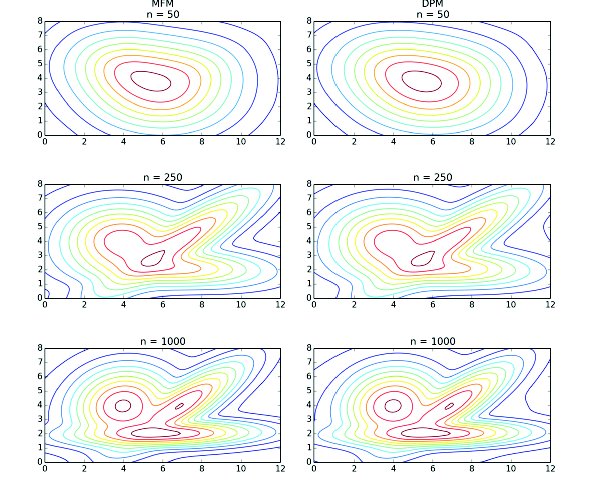 Richard Everitt and co-authors have arXived a preliminary version of a paper entitled Sequential Bayesian inference for mixture models and the coalescent using sequential Monte Carlo samplers with transformations. The central notion is an SMC version of the Carlin & Chib (1995) completion in the comparison of models in different dimensions. Namely to create auxiliary variables for each model in such a way that the dimension of the completed models are all the same. (Reversible jump MCMC à la Peter Green (1995) can also be interpreted this way, even though only relevant bits of the completion are used in the transitions.) I find the paper and the topic most interesting if only because it relates to earlier papers of us on population Monte Carlo. It also brought to my awareness the paper by Karagiannis and Andrieu (2013) on annealed reversible jump MCMC that I had missed at the time it appeared. The current paper exploits this annealed expansion in the devising of the moves. (Sequential Monte Carlo on a sequence of models with increasing dimension has been studied in the past.)
The way the SMC is described in the paper, namely, reweight-subsample-move, does not strike me as the most efficient as I would try to instead move-reweight-subsample, using a relevant move that incorporate the new model and hence enhance the chances of not rejecting.
One central application of the paper is mixture models with an unknown number of components. The SMC approach applied to this problem means creating a new component at each iteration t and moving the existing particles after adding the parameters of the new component. Since using the prior for this new part is unlikely to be at all efficient, a split move as in Richardson and Green (1997) can be considered, which brings back the dreaded Jacobian of RJMCMC into the picture! Here comes an interesting caveat of the method, namely that the split move forces a choice of the split component of the mixture. However, this does not appear as a strong difficulty, solved in the paper by auxiliary [index] variables, but possibly better solved by a mixture representation of the proposal, as in our PMC [population Monte Carlo] papers. Which also develop a family of SMC algorithms, incidentally. We found there that using a mixture representation of the proposal achieves a provable variance reduction.
“This puts a requirement on TSMC that the single transition it makes must be successful.”
As pointed by the authors, the transformation SMC they develop faces the drawback that a given model is only explored once in the algorithm, when moving to the next model. On principle, there would be nothing wrong in including regret steps, retracing earlier models in the light of the current one, since each step is an importance sampling step valid on its own right. But SMC also offers a natural albeit potentially high-varianced approximation to the marginal likelihood, which is quite appealing when comparing with an MCMC outcome. However, it would have been nice to see a comparison with alternative estimates of the marginal in the case of mixtures of distributions. I also wonder at the comparative performances of a dual approach that would be sequential in the number of observations as well, as in Chopin (2004) or our first population Monte Carlo paper (Cappé et al., 2005), since subsamples lead to tempered versions of the target and hence facilitate moves between models, being associated with flatter likelihoods.
asymptotically exact inference in likelihood-free models [a reply from the authors]
Posted in R, Statistics with tags ABC, ABC-MCMC, arXiv, Edinburgh, generator, Hamiltonian, HMC, Jacobian, likelihood-free methods, Lotka-Volterra, manifold, normalisation, pseudo-marginal MCMC, quasi-Newton resolution, reply, Riemann manifold, simulation under restrictions, simulator model on December 1, 2016 by xi'an[Following my post of lastTuesday, Matt Graham commented on the paper with force détails. Here are those comments. A nicer HTML version of the Markdown reply below is also available on Github.]
Thanks for the comments on the paper!
A few additional replies to augment what Amos wrote:
This however sounds somewhat intense in that it involves a quasi-Newton resolution at each step.
The method is definitely computationally expensive. If the constraint function is of the form of a function from an M-dimensional space to an N-dimensional space, with M≥N, for large N the dominant costs at each timestep are usually the constraint Jacobian (∂c/∂u) evaluation (with reverse-mode automatic differentiation this can be evaluated at a cost of O(N) generator / constraint evaluations) and Cholesky decomposition of the Jacobian product (∂c/∂u)(∂c/∂u)‘ with O(N³) cost (though in many cases e.g. i.i.d. or Markovian simulated data, structure in the generator Jacobian can be exploited to give a significantly reduced cost). Each inner Quasi-Newton update involves a pair of triangular solve operations which have a O(N²) cost, two matrix-vector multiplications with O(MN) cost, and a single constraint / generator function evaluation; the number of Quasi-Newton updates required for convergence in the numerical experiments tended to be much less than N hence the Quasi-Newton iteration tended not to be the main cost.
The high computation cost per update is traded off however with often being able to make much larger proposed moves in high-dimensional state spaces with a high chance of acceptance compared to ABC MCMC approaches. Even in the relatively small Lotka-Volterra example we provide which has an input dimension of 104 (four inputs which map to ‘parameters’, and 100 inputs which map to ‘noise’ variables), the ABC MCMC chains using the coarse ABC kernel radius ϵ=100 with comparably very cheap updates were significantly less efficient in terms of effective sample size / computation time than the proposed constrained HMC approach. This was in large part due to the elliptical slice sampling updates in the ABC MCMC chains generally collapsing down to very small moves even for this relatively coarse ϵ. Performance was even worse using non-adaptive ABC MCMC methods and for smaller ϵ, and for higher input dimensions (e.g. using a longer sequence with correspondingly more random inputs) the comparison becomes even more favourable for the constrained HMC approach. Continue reading
Optimization Monte Carlo: Efficient and embarrassingly parallel likelihood-free inference
Posted in Books, Statistics, Travel with tags ABC, embarassingly parallel, inverse cdf, Jacobian, London, Monte Carlo Statistical Methods, pseudo-random generator, quasi-Monte Carlo, simulation on December 16, 2015 by xi'an
 Ted Meeds and Max Welling have not so recently written about an embarrassingly parallel approach to ABC that they call optimisation Monte Carlo. [Danke Ingmar for pointing out the reference to me.] They start from a rather innocuous rephrasing of the ABC posterior, writing the pseudo-observations as deterministic transforms of the parameter and of a vector of uniforms. Innocuous provided this does not involve an infinite number of uniforms, obviously. Then they suddenly switch to the perspective that, for a given uniform vector u, one should seek the parameter value θ that agrees with the observation y. A sort of Monte Carlo inverse regression: if
y=f(θ,u),
then invert this equation in θ. This is quite clever! Maybe closer to fiducial than true Bayesian statistics, since the prior does not occur directly [only as a weight p(θ)], but if this is manageable [and it all depends on the way f(θ,u) is constructed], this should perform better than ABC! After thinking about it a wee bit more in London, though, I realised this was close to impossible in the realistic examples I could think of. But I still like the idea and want to see if anything at all can be made of this…
“However, it is hard to detect if our optimization succeeded and we may therefore sometimes reject samples that should not have been rejected. Thus, one should be careful not to create a bias against samples u for which the optimization is difficult. This situation is similar to a sampler that will not mix to remote local optima in the posterior distribution.”
Now, the paper does not go that way but keeps the ε-ball approach as in regular ABC, to derive an approximation of the posterior density. For a while I was missing the difference between the centre of the ball and the inverse of the above equation, bottom of page 3. But then I realised the former was an approximation to the latter. When the authors discuss their approximation in terms of the error ε, I remain unconvinced by the transfer of the tolerance to the optimisation error, as those are completely different notions. This also applies to the use of a Jacobian in the weight, which seems out of place since this Jacobian appears in a term associated with (or replacing) the likelihood, f(θ,u), which is then multiplied by the prior p(θ). (Assuming a Jacobian exists, which is unclear when considering most simulation patterns use hard bounds and indicators.) When looking at the toy examples, it however makes sense to have a Jacobian since the selected θ’s are transforms of the u’s. And the p(θ)’s are simply importance weights correcting for the wrong target. Overall, the appeal of the method proposed in the paper remains unclear to me. Most likely because I did not spend enough time over it.


