After a rather intense period of new simulations and versions, Juong Een (Kate) Lee and I have now resubmitted our paper on (some) importance sampling schemes for evidence approximation in mixture models to Bayesian Analysis. There is no fundamental change in the new version but rather a more detailed description of what those importance schemes mean in practice. The original idea in the paper is to improve upon the Rao-Blackwellisation solution proposed by Berkoff et al. (2002) and later by Marin et al. (2005) to avoid the impact of label switching on Chib’s formula. The Rao-Blackwellisation consists in averaging over all permutations of the labels while the improvement relies on the elimination of useless permutations, namely those that produce a negligible conditional density in Chib’s (candidate’s) formula. While the improvement implies truncated the overall sum and hence induces a potential bias (which was the concern of one referee), the determination of the irrelevant permutations after relabelling next to a single mode does not appear to cause any bias, while reducing the computational overload. Referees also made us aware of many recent proposals that conduct to different evidence approximations, albeit not directly related with our purpose. (One was Rodrigues and Walker, 2014, discussed and commented in a recent post.)
Archive for label switching
importance sampling schemes for evidence approximation [revised]
Posted in Statistics, University life with tags Andrew Gelman, candidate approximation, Chib's approximation, evidence, finite mixtures, label switching, permutations, Rao-Blackwellisation on November 18, 2014 by xi'anlabel switching in Bayesian mixture models
Posted in Books, Statistics, University life with tags component of a mixture, convergence, finite mixtures, identifiability, ill-posed problem, invariance, label switching, loss function, MCMC algorithms, missing data, multimodality, relabelling on October 31, 2014 by xi'an A referee of our paper on approximating evidence for mixture model with Jeong Eun Lee pointed out the recent paper by Carlos Rodríguez and Stephen Walker on label switching in Bayesian mixture models: deterministic relabelling strategies. Which appeared this year in JCGS and went beyond, below or above my radar.
Label switching is an issue with mixture estimation (and other latent variable models) because mixture models are ill-posed models where part of the parameter is not identifiable. Indeed, the density of a mixture being a sum of terms
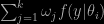
the parameter (vector) of the ω’s and of the θ’s is at best identifiable up to an arbitrary permutation of the components of the above sum. In other words, “component #1 of the mixture” is not a meaningful concept. And hence cannot be estimated.
This problem has been known for quite a while, much prior to EM and MCMC algorithms for mixtures, but it is only since mixtures have become truly estimable by Bayesian approaches that the debate has grown on this issue. In the very early days, Jean Diebolt and I proposed ordering the components in a unique way to give them a meaning. For instant, “component #1” would then be the component with the smallest mean or the smallest weight and so on… Later, in one of my favourite X papers, with Gilles Celeux and Merrilee Hurn, we exposed the convergence issues related with the non-identifiability of mixture models, namely that the posterior distributions were almost always multimodal, with a multiple of k! symmetric modes in the case of exchangeable priors, and therefore that Markov chains would have trouble to visit all those modes in a symmetric manner, despite the symmetry being guaranteed from the shape of the posterior. And we conclude with the slightly provocative statement that hardly any Markov chain inferring about mixture models had ever converged! In parallel, time-wise, Matthew Stephens had completed a thesis at Oxford on the same topic and proposed solutions for relabelling MCMC simulations in order to identify a single mode and hence produce meaningful estimators. Giving another meaning to the notion of “component #1”.
And then the topic began to attract more and more researchers, being both simple to describe and frustrating in its lack of definitive answer, both from simulation and inference perspectives. Rodriguez’s and Walker’s paper provides a survey on the label switching strategies in the Bayesian processing of mixtures, but its innovative part is in deriving a relabelling strategy. Which consists of finding the optimal permutation (at each iteration of the Markov chain) by minimising a loss function inspired from k-means clustering. Which is connected with both Stephens’ and our [JASA, 2000] loss functions. The performances of this new version are shown to be roughly comparable with those of other relabelling strategies, in the case of Gaussian mixtures. (Making me wonder if the choice of the loss function is not favourable to Gaussian mixtures.) And somehow faster than Stephens’ Kullback-Leibler loss approach.
“Hence, in an MCMC algorithm, the indices of the parameters can permute multiple times between iterations. As a result, we cannot identify the hidden groups that make [all] ergodic averages to estimate characteristics of the components useless.”
One section of the paper puzzles me, albeit it does not impact the methodology and the conclusions. In Section 2.1 (p.27), the authors consider the quantity

which is the marginal probability of allocating observation i to cluster or component j. Under an exchangeable prior, this quantity is uniformly equal to 1/k for all observations i and all components j, by virtue of the invariance under permutation of the indices… So at best this can serve as a control variate. Later in Section 2.2 (p.28), the above sentence does signal a problem with those averages but it seem to attribute it to MCMC behaviour rather than to the invariance of the posterior (or to the non-identifiability of the components per se). At last, the paper mentions that “given the allocations, the likelihood is invariant under permutations of the parameters and the allocations” (p.28), which is not correct, since eqn. (8)

does not hold when the two permutations σ and τ give different images of zi…
my life as a mixture [BAYSM 2014, Wien]
Posted in Books, Kids, Mountains, pictures, Statistics, Travel, University life with tags Austria, Bayes factor, Bayesian tests of hypotheses, BAYSM, Gibbs sampling, importance sampling, label switching, Linz, mixtures, Vienna, WU Wirtschaftsuniversität Wien on September 12, 2014 by xi'an Next week I am giving a talk at BAYSM in Vienna. BAYSM is the Bayesian Young Statisticians meeting so one may wonder why, but with Chris Holmes and Mike West, we got invited as more… erm… senior speakers! So I decided to give a definitely senior talk on a thread pursued throughout my career so far, namely mixtures. Plus it also relates to works of the other senior speakers. Here is the abstract for the talk:
Mixtures of distributions are fascinating objects for statisticians in that they both constitute a straightforward extension of standard distributions and offer a complex benchmark for evaluating statistical procedures, with a likelihood both computable in a linear time and enjoying an exponential number of local models (and sometimes infinite modes). This fruitful playground appeals in particular to Bayesians as it constitutes an easily understood challenge to the use of improper priors and of objective Bayes solutions. This talk will review some ancient and some more recent works of mine on mixtures of distributions, from the 1990 Gibbs sampler to the 2000 label switching and to later studies of Bayes factor approximations, nested sampling performances, improper priors, improved importance samplers, ABC, and a inverse perspective on the Bayesian approach to testing of hypotheses.
I am very grateful to the scientific committee for this invitation, as it will give me the opportunity to meet the new generation, learn from them and in addition discover Vienna where I have never been, despite several visits to Austria. Including its top, the Großglockner. I will also give a seminar in Linz the day before. In the Institut für Angewandte Statistik.
Importance sampling schemes for evidence approximation in mixture models
Posted in R, Statistics, University life with tags arXiv, Chib's approximation, evidence, label switching, marginal likelihood, mixture estimation, Monte Carlo Statistical Methods, path sampling, permutations, subsampling on November 27, 2013 by xi'an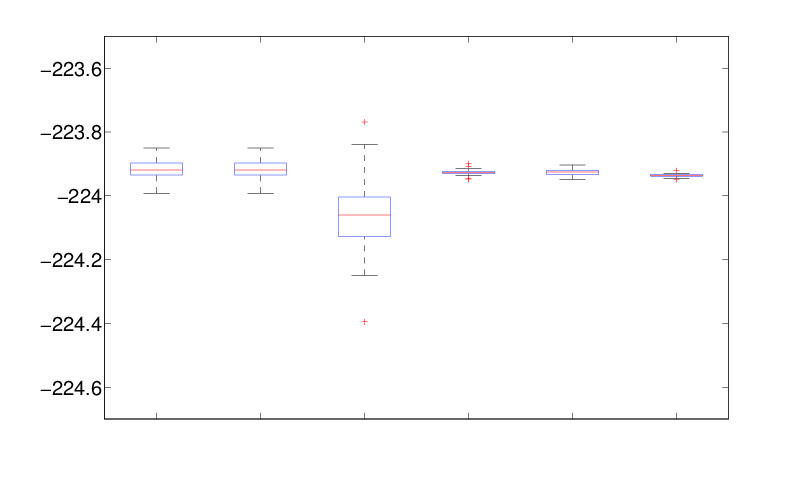 Jeong Eun (Kate) Lee and I completed this paper, “Importance sampling schemes for evidence approximation in mixture models“, now posted on arXiv. (With the customary one-day lag for posting, making me bemoan the days of yore when arXiv would give a definitive arXiv number at the time of submission.) Kate came twice to Paris in the past years to work with me on this evaluation of Chib’s original marginal likelihood estimate (also called the candidate formula by Julian Besag). And on the improvement proposed by Berkhof, van Mechelen, and Gelman (2003), based on averaging over all permutations, idea that we rediscovered in an earlier paper with Jean-Michel Marin. (And that Andrew seemed to have completely forgotten. Despite being the very first one to publish [in English] a paper on a Gibbs sampler for mixtures.) Given that this averaging can get quite costly, we propose a preliminary step to reduce the number of relevant permutations to be considered in the averaging, removing far-away modes that do not contribute to the Rao-Blackwell estimate and called dual importance sampling. We also considered modelling the posterior as a product of k-component mixtures on the components, following a vague idea I had in the back of my mind for many years, but it did not help. In the above boxplot comparison of estimators, the marginal likelihood estimators are
- Chib’s method using T = 5000 samples with a permutation correction by multiplying by k!.
- Chib’s method (1), using T = 5000 samples which are randomly permuted.
- Importance sampling estimate (7), using the maximum likelihood estimate (MLE) of the latents as centre.
- Dual importance sampling using q in (8).
- Dual importance sampling using an approximate in (14).
- Bridge sampling (3). Here, label switching is imposed in hyperparameters.
On the use of marginal posteriors in marginal likelihood estimation via importance-sampling
Posted in R, Statistics, University life with tags Bayes factor, Chib's approximation, evidence, harmonic mean estimator, label switching, latent variable, marginal likelihood, MCMC, mixtures, Monte Carlo Statistical Methods, nested sampling, Poisson regression, Rao-Blackwellisation, simulation on November 20, 2013 by xi'anPerrakis, Ntzoufras, and Tsionas just arXived a paper on marginal likelihood (evidence) approximation (with the above title). The idea behind the paper is to base importance sampling for the evidence on simulations from the product of the (block) marginal posterior distributions. Those simulations can be directly derived from an MCMC output by randomly permuting the components. The only critical issue is to find good approximations to the marginal posterior densities. This is handled in the paper either by normal approximations or by Rao-Blackwell estimates. the latter being rather costly since one importance weight involves B.L computations, where B is the number of blocks and L the number of samples used in the Rao-Blackwell estimates. The time factor does not seem to be included in the comparison studies run by the authors, although it would seem necessary when comparing scenarii.
After a standard regression example (that did not include Chib’s solution in the comparison), the paper considers 2- and 3-component mixtures. The discussion centres around label switching (of course) and the deficiencies of Chib’s solution against the current method and Neal’s reference. The study does not include averaging Chib’s solution over permutations as in Berkoff et al. (2003) and Marin et al. (2005), an approach that does eliminate the bias. Especially for a small number of components. Instead, the authors stick to the log(k!) correction, despite it being known for being quite unreliable (depending on the amount of overlap between modes). The final example is Diggle et al. (1995) longitudinal Poisson regression with random effects on epileptic patients. The appeal of this model is the unavailability of the integrated likelihood which implies either estimating it by Rao-Blackwellisation or including the 58 latent variables in the analysis. (There is no comparison with other methods.)
As a side note, among the many references provided by this paper, I did not find trace of Skilling’s nested sampling or of safe harmonic means (as exposed in our own survey on the topic).


