On Monday, Paul Fearnhead and Benjamin Taylor reposted on arXiv a paper about adaptive SMC. It is as well since I had missed the first posting on Friday. While the method has some similarities with our earlier work on population Monte Carlo methods with Olivier Cappé, Randal Douc, Arnaud Guillin and Jean-Michel Marin, there are quite novel and interesting features in this paper! First, the paper is firmly set within a sequential setup, as in Chopin (2002, Biometrika) and Del Moral, Doucet and Jasra (2006, JRSS B). This means considering a sequence of targets corresponding to likelihoods with increasing datasets. We mentioned this case as a possible implementation of population Monte Carlo but never truly experimented with this. Fearnhead and Taylor do set their method within this framework, using a sequence of populations (or particle systems) aimed at this moving sequence of targets. The second major difference is that, while they also use a mixture of transition kernels as their proposal (or importance functions) and while they also aim at optimising the parameters of those transitions (parameters that I would like to dub cyberparameters to distinguish them from the parameters of the statistical model), they do not update those cyberparameters in a deterministic way, as we do. On the opposite, they build a non-parametric approximation 


Archive for population Monte Carlo
Adaptive SMC
Posted in Statistics with tags adaptive MCMC methods, controlled MCMC, cyberparameter, mixtures, particle learning, population Monte Carlo, sequential Monte Carlo, simulation on May 14, 2010 by xi'ant-walk on the banana side
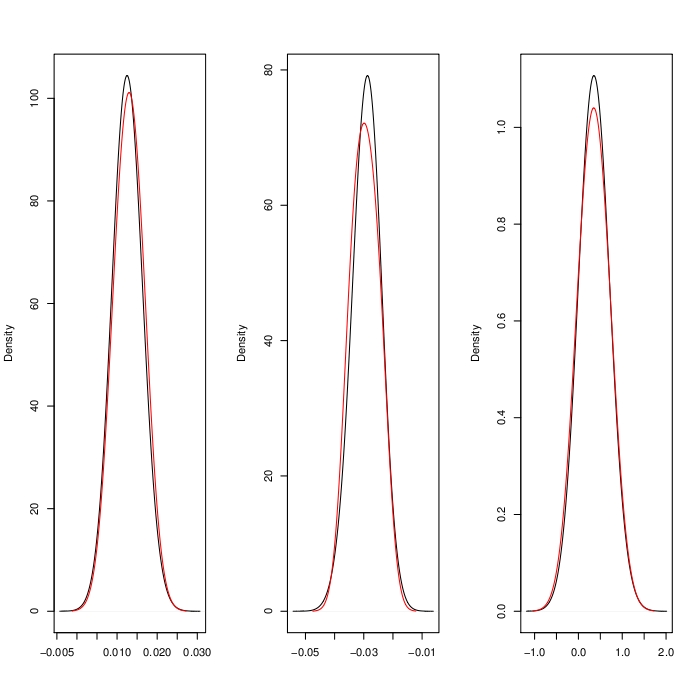
Posted in R, Statistics with tags adaptive MCMC methods, MCMC, Monte Carlo methods, population Monte Carlo, random walk on March 15, 2010 by xi'anFollowing my remarks on the t-walk algorithm in the recent A General Purpose Sampling Algorithm for Continuous Distributions, published by Christen and Fox in Bayesian Analysis that acts like a general purpose MCMC algorithm, Darren Wraith tested it on the generic (10 dimension) banana target we used in the cosmology paper. Here is an output from his comparison R program:

 The use of the t-walk algorithm (left, with the same number of particles) in this very special case thus produces a wider variability on the estimated means than the use of adaptive MCMC (center) and our (tuned) PMC algorithm (right).
“Bayesian model comparison in cosmology” is back!
Posted in Statistics with tags Bayesian model choice, cosmology, MNRAS, population Monte Carlo, revision on February 18, 2010 by xi'anWe already have the review back on our paper from Monthly Notices of the Royal Astronomical Society. And it is quite positive!
Dear Dr Kilbinger
I attach the reviewer’s comments on your manuscript entitled “Bayesian model comparison in cosmology with Population Monte Carlo”, ref. MN-09-2486-MJ, which you submitted to Monthly Notices of the Royal Astronomical Society.
Minor revision of your manuscript is requested before it is reconsidered for publication.
The referee is very enthusiastic:
The importance of the paper, in my view, stems more from the methodology presented than from its application to current data. I have only a few very minor comments concerning typos and a few points where I believe slight re-wording might make the paper clearer – especially to a non-specialist (i.e. non-statistician) reader.
I thus think we can have a revision ready within a few days and send it back to Monthly Notices of the Royal Astronomical Society, hopefully with a final and positive result!
Two more handbook chapters
Posted in Books, Statistics with tags ABC, ABC-SMC, Bayesian methods and expert elicitation, computational statistics, handbook of computational statistics, Monte Carlo methods, Pima Indian, population Monte Carlo, probit model, reversible jump on February 16, 2010 by xi'anAs mentioned in my earlier post, I had to write a revised edition to my chapter Bayesian Computational Methods in the Handbook of Computational Statistics (second edition), edited by J. Gentle, W. Härdle and Y. Mori. And in parallel I was asked for a second chapter in a handbook on risk analysis, Bayesian methods and expert elicitation, edited by Klaus Böckner. So, on Friday, I went over the first edition of this chapter of the Handbook of Computational Statistics and added the most recent developments I deemed important to mention, like ABC, as well as recent SMC and PMC algorithms, increasing the length by about ten pages. Simultaneously, Jean-Michel Marin completed my draft for the other handbook and I submitted both chapters, as well as arXived one and then the other.
It is somehow interesting (on a lazy blizzardly Sunday afternoon with nothing better to do!) to look for the differences between those chapters aiming at the same description of important computational techniques for Bayesian statistics (and based on the same skeleton). The first chapter is broader and, with its 60 pages, it functions as a (very) short book on the topic. Given that the first version was written in 2003, the focus is more on latent variables with mixture models being repeatedly used as examples. Reversible jump also stands preeminently. In my opinion, it reads well and could be used as a primary entry for a short formal course on computational methods. (Even though Introducing Monte Carlo Methods with R is presumably more appropriate for a short course.)
 The second chapter started from the skeleton of the earlier version of the first chapter with the probit model as the benchmark example. I worked on a first draft during the last vacations and then Jean-Michel took over to produce this current version, where reversible jump has been removed and ABC introduced with greater details. In particular, we used a very special version of ABC with the probit model, resorting to the distance between the expectations of the binary observables, namely

where 


which incorporates a useless randomness. With this choice, and when using for 
Bayesian model comparison in cosmology with population Monte Carlo
Posted in Statistics with tags adaptivity, Bayesian model choice, cosmology, evidence, MCMC, nested sampling, parallelisation, population Monte Carlo, simulation on December 11, 2009 by xi'anThe paper on evidence approximation by population Monte Carlo that I mentioned in a previous post is now arXived. (This is the second paper jointly produced by the members of the 2005-2009 ANR Ecosstat.) The full abstract is
“We use Bayesian model selection techniques to test extensions of the standard flat ACDM paradigm. Dark-energy and curvature scenarios, and primordial perturbation models are considered. To that end, we calculate the Bayesian evidence in favour of each model using Population Monte Carlo (PMC), a new adaptive sampling technique which was recently applied in a cosmological context. In contrast to the case of other sampling-based inference techniques such as Markov chain Monte Carlo (MCMC), the Bayesian evidence is immediately available from the PMC sample used for parameter estimation without further computational eff ort, and it comes with an associated error evaluation. Besides, it provides an unbiased estimator of the evidence after any fixed number of iterations and it is naturally parallelisable, in contrast with MCMC and nested sampling methods. By comparison with analytical predictions for simulated data, we show that our results obtained with PMC are reliable and robust. The variability in the evidence evaluation and the stability for various cases are estimated both from simulations and from data. For the cases we consider, the log-evidence is calculated with a precision of better than 0:08.
Using a combined set of recent CMB, SNIa and BAO data, we fi nd inconclusive evidence between at ACDM and simple dark-energy models. A curved Universe is moderately to strongly disfavoured with respect to a flat cosmology. Using physically well-motivated priors within the slow-roll approximation of inflation, we find a weak preference for a running spectral index. A Harrison-Zel’dovich spectrum is weakly disfavoured. With the current data, tensor modes are not detected; the large prior volume on the tensor-to-scalar ratio r results in moderate evidence in favour of r = 0.”
and we run an evaluation of the PMC based approximation to the evidence that shows that this particular importance sampling technique allows for an associated evalution of the uncertainty surrounding this approximation. A posteriori, I think we should have included a comparison with nested sampling, since this technique is now very much in use in astronomy, but this will have to wait for another paper.
 Note that the paper details the fact that the variance of the evidence approximation

is connected with the chi-square distance 

if 


