When I first read Le Monde puzzle this weekend, I though it was even less exciting than the previous one: find
 and
and  ,
,
such that
 is a multiple of
  .
.
The solution is obtained by brute-force checking through an R program:

and then the a next solution is  (with several values for N).
However, while waiting in the plane to Edinburgh, I thought more about it and found that the problem can be solved with paper and pencil. It goes like this. There exists an integer
 such that
Hence, solving the second degree equation,

which implies that

is one of the integral factors of . If we write
 with
with 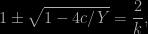
we get

and thus
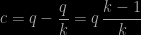 .
.
We thus deduce that  is an integer, meaning that
  and thus that
  is an integer factor of . This obviously restricts the choice of , especially when considering that
  implies
  . Furthermore, the solutions to the second degree equations are then given by
 .
.
The conclusion is thus that any which can be divided by a squared integer larger than or equal to  provides a solution. Now, if we look at the decomposition of
 ,
,
 ,
,
 ,
,
 ,
,
 ,
,
 ,
,
 ,
,
we see (without any R programming) that  is the smallest solution (in ).
  is the smallest solution with
  a possible solution in
  (
( being another one). Which makes (at least) for a more bearable diversion in the plane…
An approach avoiding the second degree equation is to notice that  implies that and share a largest common divider
  , i.e.

which implies
 ,
,
thus that  divides
  (because both other terms are prime with ). Eliminating dividers common to and
  actually leads to
  , hence to the same conclusion as before.
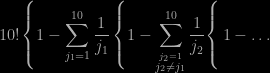

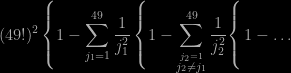
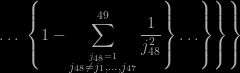
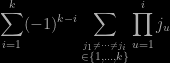
 . This is simply
 , equal to -1 for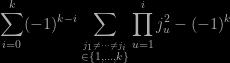

 . A bit disappointing because it amounts to reformulate the question with the proper algebraic formula…

