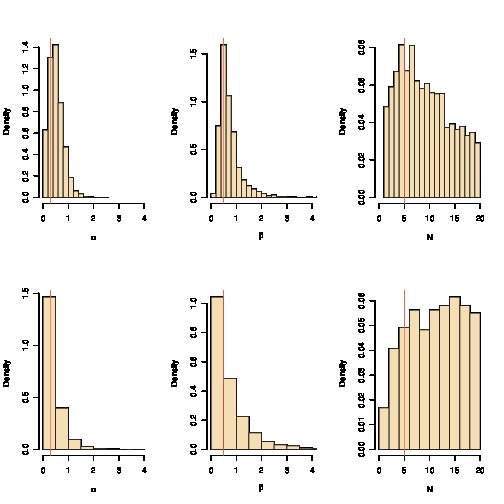
We (Kerrie Mengersen, Pierre Pudlo, and myself) have now revised our ABC with empirical likelihood paper and resubmitted both to arXiv and to PNAS as “Approximate Bayesian computation via empirical likelihood“. The main issue raised by the referees was that the potential use of the empirical likelihood (EL) approximation is much less widespread than the possibility of simulating pseudo-data, because EL essentially relies on an iid sample structure, plus the availability of parameter defining moments. This is indeed the case to some extent and also the reason why we used a compound likelihood for our population genetic model. There are in fact many instances where we simply cannot come up with a regular EL approximation… However, the range of applications of straight EL remains wide enough to be of interest, as it includes most dynamical models like hidden Markov models. To illustrate this point further, we added (in this revision) an example borrowed from the recent Biometrika paper by David Cox and Christiana Kartsonaki (which proposes a frequentist alternative to ABC based on fractional design). This model ended up being fairly appealing wrt our perspective: while the observed data is dependent in a convoluted way, being a superposition of N renewal processes with gamma waiting times, it is possible to recover an iid structure at the same cost as a regular ABC algorithm by using the pseudo-data to recover an iid process (the sequence of renewal processes indicators)…The outcome is quite favourable to ABCel in this particular case, as shown by the graph below (top: ABCel, bottom: ABC, red line:truth):
 This revision (started while visiting Kerrie in Brisbane) was thus quite beneficial to our perception of ABC in that (a) it is indeed not as universal as regular ABC and this restriction should be spelled out (the advantage being that, when it can be implemented, it usually runs much much faster!), and (b) in cases where the pseudo-data must be simulated, EL provides a reference/benchmark for the ABC output that comes for free… Now I hope to manage to get soon out of the “initial quality check” barrage to reach the Editorial Board!