Following the informed and helpful comments from Matt Graham and Bob Carpenter on our eHMC paper [arXival] last month, we produced a revised and re-arXived version of the paper based on new experiments ran by Changye Wu and Julien Stoehr. Here are some quick replies to these comments, reproduced for convenience. (Warning: this is a loooong post, much longer than usual.) Continue reading
Archive for revision
revised empirical HMC
Posted in Statistics, University life with tags eHMC, github, Hamiltonian Monte Carlo, leapfrog integrator, NUTS, Rao-Blackwellisation, revision, scaling, STAN on March 12, 2019 by xi'anmixture modelling for testing hypotheses
Posted in Books, Statistics, University life with tags Bayes factor, Bayesian hypothesis testing, Christophe Andrieu, controlled MCMC, JRSSB, peer review, Read paper, revision, testing as mixture estimation, Ultimixt, University of Bristol on January 4, 2019 by xi'an After a fairly long delay (since the first version was posted and submitted in December 2014), we eventually revised and resubmitted our paper with Kaniav Kamary [who has now graduated], Kerrie Mengersen, and Judith Rousseau on the final day of 2018. The main reason for this massive delay is mine’s, as I got fairly depressed by the general tone of the dozen of reviews we received after submitting the paper as a Read Paper in the Journal of the Royal Statistical Society. Despite a rather opposite reaction from the community (an admittedly biased sample!) including two dozens of citations in other papers. (There seems to be a pattern in my submissions of Read Papers, witness our earlier and unsuccessful attempt with Christophe Andrieu in the early 2000’s with the paper on controlled MCMC, leading to 121 citations so far according to G scholar.) Anyway, thanks to my co-authors keeping up the fight!, we started working on a revision including stronger convergence results, managing to show that the approach leads to an optimal separation rate, contrary to the Bayes factor which has an extra √log(n) factor. This may sound paradoxical since, while the Bayes factor converges to 0 under the alternative model exponentially quickly, the convergence rate of the mixture weight α to 1 is of order 1/√n, but this does not mean that the separation rate of the procedure based on the mixture model is worse than that of the Bayes factor. On the contrary, while it is well known that the Bayes factor leads to a separation rate of order √log(n) in parametric models, we show that our approach can lead to a testing procedure with a better separation rate of order 1/√n. We also studied a non-parametric setting where the null is a specified family of distributions (e.g., Gaussians) and the alternative is a Dirichlet process mixture. Establishing that the posterior distribution concentrates around the null at the rate √log(n)/√n. We thus resubmitted the paper for publication, although not as a Read Paper, with hopefully more luck this time!
barbed WIREs
Posted in Books, Kids, University life with tags commercial editor, computational statistics, John Wiley, managing editor, revision, WIREs, WIREs Computational Statistics on July 14, 2018 by xi'an
Maybe childishly, I am fairly unhappy with the way the submission of our Accelerating MCMC review was handled by WIREs Computational Statistics, i.e., Wiley, at the production stage. For some reason, or another, I sent the wrong bibTeX file with my LaTeX document [created using the style file imposed by WIREs]. Rather than pointing out the numerous missing entries, the production staff started working on the paper and sent us a proof with an endless list of queries related to these missing references. When I sent back the corrected LaTeX and bibTeX files, it answered back that it was too late to modify the files as it would “require re-work of [the] already processed paper which is also not a standard process for the journal”. Meaning in clearer terms that Wiley does not want to pay any additional time spent on this paper and that I have to provide from my own “free” time to make up for this mess…
on the Jeffreys-Lindley’s paradox (revision)
Posted in Statistics, University life with tags Aris Spanos, Bayesian foundations, Dennis Lindley, improper priors, Jeffreys-Lindley paradox, paradoxes, philosophy, Philosophy of Science, review, revision on September 17, 2013 by xi'an As mentioned here a few days ago, I have been revising my paper on the Jeffreys-Lindley’s paradox paper for Philosophy of Science. It came as a bit of a (very pleasant) surprise that this journal was ready to consider a revised version of the paper given that I have no formal training in philosophy and that the (first version of the) paper was rather hurriedly made of a short text written for the 95th birthday of Dennis Lindley and of my blog post on Aris Spanos’ “Who should be afraid of the Jeffreys-Lindley paradox?“, recently published in Philosophy of Science. So I found both reviewers very supportive and I am grateful for their suggestions to improve both the scope and the presentation of the paper. It has been resubmitted and rearXived, and I am now waiting for the decision of the editorial team with the appropriate philosophical sense of detachment…
ABC with empirical likelihood (second round)
Posted in Statistics, University life with tags ABC, AMSI, Australia, Brisbane, empirical likelihood, PNAS, referee, renewal process, revision on September 18, 2012 by xi'an
We (Kerrie Mengersen, Pierre Pudlo, and myself) have now revised our ABC with empirical likelihood paper and resubmitted both to arXiv and to PNAS as “Approximate Bayesian computation via empirical likelihood“. The main issue raised by the referees was that the potential use of the empirical likelihood (EL) approximation is much less widespread than the possibility of simulating pseudo-data, because EL essentially relies on an iid sample structure, plus the availability of parameter defining moments. This is indeed the case to some extent and also the reason why we used a compound likelihood for our population genetic model. There are in fact many instances where we simply cannot come up with a regular EL approximation… However, the range of applications of straight EL remains wide enough to be of interest, as it includes most dynamical models like hidden Markov models. To illustrate this point further, we added (in this revision) an example borrowed from the recent Biometrika paper by David Cox and Christiana Kartsonaki (which proposes a frequentist alternative to ABC based on fractional design). This model ended up being fairly appealing wrt our perspective: while the observed data is dependent in a convoluted way, being a superposition of N renewal processes with gamma waiting times, it is possible to recover an iid structure at the same cost as a regular ABC algorithm by using the pseudo-data to recover an iid process (the sequence of renewal processes indicators)…The outcome is quite favourable to ABCel in this particular case, as shown by the graph below (top: ABCel, bottom: ABC, red line:truth):
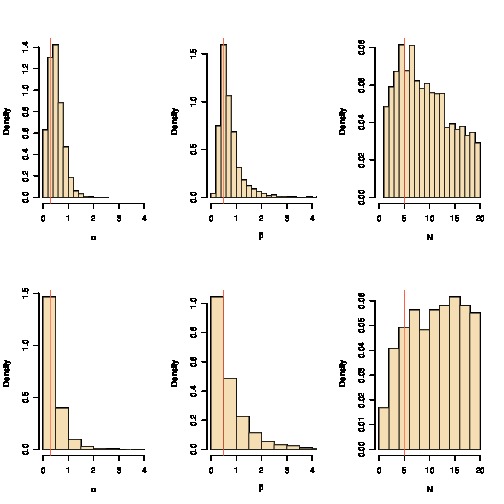 This revision (started while visiting Kerrie in Brisbane) was thus quite beneficial to our perception of ABC in that (a) it is indeed not as universal as regular ABC and this restriction should be spelled out (the advantage being that, when it can be implemented, it usually runs much much faster!), and (b) in cases where the pseudo-data must be simulated, EL provides a reference/benchmark for the ABC output that comes for free… Now I hope to manage to get soon out of the “initial quality check” barrage to reach the Editorial Board!

