Archive for safe Bayes

safe Bayes & e-values & least favourable priors

Posted in Books, pictures, Statistics, University life with tags , , , , , , , , , , , , , , , , , , , , , , on March 2, 2024 by xi'an

The paper by Peter Grünwald, Rianne de Heide and Wouter Koolen on safe testing was read before The Royal Statistical Society at a meeting organized by the Research Section on Wednesday, 24th January, 2024, after many years in the making, to the point that several papers based on this initial one have appeared in the meanwhile, incl. some submissions to Biometrika. Like this one in the current issue of Statistical Science dedicated to reproducibility and replicability. Joshua Bon and I wrote a discussion that synthesised the following and sometimes rambling remarks.

Overall, this is a mind-challenging paper with definitely original style and contents for which the authors are to be congratulated!

“…p-values are interpreted as indicating amounts of evidence against the null, and their definition does not need to refer to any specific alternative H¹. Exactly the same holds for e-values: the basic interpretation ‘a large e-value provides evidence against H⁰’ holds no matter how the e-variable is defined, as long as it satisfies (1). If they are defined relative to H¹ that is close to the actual process generating the data they will grow fast and provide a lot of evidence, but the basic interpretation holds regardless.”

About the entry section, one may ask why would a Bayesian want to test the veracity of a null hypothesis. The debate has been raging since the early days, although Jeffreys spent two chapters of his book on the topic of testing. (While appearing in Example 5 p.14 for his point estimation prior.) From an opposite viewpoint, the construction of e-values and such in the paper is highly model dependent, but all models are wrong! and more to the point both hypotheses may turn out to be wrong for misspecified cases. The notion thus seems on the opposite to be very M-close, with no idea of what is happening under misspecified models or why is rejecting H⁰ the ultimate argument.

When introducing e-values, (1) is not a definition per se, since otherwise E≡1 would be an e-value. This is unfortunate as the topic is already confusing enough. E[E] must be larger than 1 under H¹, otherwise product of e-values would always degenerate to zero (?)

The points

  1. behaviour under optional continuation [by a martingale reasoning]
  2. interpretation as ‘evidence against the null’ as gambling [unethical!]
  3. in all cases preserving frequentist Type I error guarantees
  4. e-variables turn out to be Bayes factors based on the right Haar prior [rather than sometimes with highly unusual (e.g. degenerate) priors? p.4]
  5. e-variables need more extreme data than p-values in order to reject the null

are rather worthwhile, even though 2. is vague and 3. is firmly frequentist. Any theory involving Haar priors (and even better amenability) cannot be all wrong, though, even considering that Haar priors are improper. The optional continuation in 1. is a nice argument from a Bayesian viewpoint since it has also been used to defend the Bayesian approach. Point 4. brings a formal way to define least favourable priors in the testing sense. One may then wonder at the connection with the solution of Bayarri and Garcia-Donato (Biometrika, 2007). The perspective adopted therein is somehow an inverse of the more common stance when the prior on H⁰ is the starting point [and obviously known]. So, is there any dual version of e-values where this would happen, i.e. leading to deriving the optimal prior on H¹ for a given prior on H⁰? (Which would further offer a maximin interpretation.) Theorem 1 indeed sounds like the minimax=maximin result for test settings. (In Corollary 2, why is (10) necessarily a Bayes factor, given the two models?)

While I first thought that the approach leads to finding a proper prior, the “Almost Bayesian Case” [p.17] (ABC!!) comes to justify the use of a “common” improper prior over nuisance parameters under both hypotheses, which while more justifiable than in the original objective Bayes literature, remains unsatisfactory to me. But I like the notion in 2.2 [p.10] that a prior chosen on H¹ forces one to adopt a particular corresponding prior on H⁰, as it defines a form of automated projection that we also considered in Goutis [RIP] and Robert (Biometrika, 1998). Corollary 2 is most interesting as well. However, taking the toy example of H⁰ being a normal mean standing in (-a,a) seems to lead to the optimal prior on H⁰ being a point mass at +/- a for any marginal m(y) centred at zero. Which is a disappointing outcome when compared with the point mass situation. It is another disappointment that the Bayes Factor cannot be an e-value since (6) fails to hold, but (1) is not (6) and one could argue that the BF is an e-value when integrating under the marginals!

As a marginalia, the paper made me learn about the term (and theme) tragedy of the commons, a concept developed by [the neomalthusian and eugenist] Garett Hardin.

In conclusion, we congratulate the authors on this endeavour but it remains unclear to us (as Bayesians) (i) how to construct the least favourable prior on H0 on a general basis, especially from a computational viewpoint, and, more importantly, (ii) whether it is at all of inferential interest [i.e., whether it degenerates into a point mass]. With respect to the sequential directions of the paper, we also wonder at the potential connections with sequential Monte Carlo, for instance, towards conducting sequential model choice by constructing efficiently an amalgamated evidence value when the product of Bayes factors is not a Bayes factor (see Buchholz et al., 2023).

Contextual Integrity for Differential Privacy #1 [23w5106]

Posted in Books, Mountains, pictures, Statistics, University life with tags , , , , , , , , , , , , , , , on August 2, 2023 by xi'an


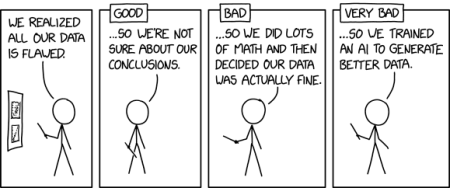
Very relaxed beginning to the workshop, with [xkcd illustrated] tutorials on CI and DP, plus informal discussions to find a common ground over the week. Helped by the beautiful surroundings of the UBC Okanagan campus. Tutorial on the fundamentals of differential privacy, with a long room discussion on the meaning(s) of the definition, for instance exhibiting the minimax nature of the thing, placing all bad events at the same level. Any Bayesian version? Still unclear [to me] how one can inverse-engineer (ε,δ) into the probability of identifying one data entry. More questions about the nature of noise in DP algorithms. Again lacking [for me] the impact on identifying one data entry. Plus notions like Laplace privacy-accuracy sound parameterisation dependent. Exponential mechanism, that involves a score function (protecting privacy?) that ends up resembling a Gibbs posterior in the “safe Bayes” perspective. Interesting distinction about which agent provides randomness as impacting the privacy.

As for contextual integrity, presented by Helen Nissenbaum at the origin of the concept, it is complicated by a strongly subjective handling of notions, first and foremost privacy, as inevitably the case in philosophy and ethics.

Better together in Kolkata [slides]

Posted in Books, pictures, Statistics, Travel, University life with tags , , , , , , , , , , , , , , , on January 4, 2018 by xi'an

Here are the slides of the talk on modularisation I am giving today at the PC Mahalanobis 125 Conference in Kolkata, mostly borrowed from Pierre’s talk at O’Bayes 2018 last month:

[which made me realise Slideshare has discontinued the option to update one’s presentation, forcing users to create a new presentation for each update!] Incidentally, the amphitheatre at ISI is located right on top of a geological exhibit room with a reconstituted Barapasaurus tagorei so I will figuratively ride a dinosaur during my talk!

the dark side of the “work hard party harder” spirit[s]

Posted in Mountains, pictures, Running, Travel, University life with tags , , , , , , , on December 20, 2017 by xi'an

Now, following the blogs of the past days about harassment at ISBA meetings, reposting Pierre’s blog about the strong unbalance between men and women attending these meetings, and then the ISBA first action towards making ISBA meetings safe(r), or more inclusive, here are some completely personal reflections on why I think the culture of “work hard party harder” that permeates these meetings needs to change. Towards “more Bayes, less booze”, to repeat from an email I received in the past few days… (As in every entry on this blog, except maybe those few pointing out factual mathematical errors, but this need be stressed, this is indeed a personal view on the topic, reacting to the news, for which I claim absolutely no expertise or superiority of any kind above other viewpoints. And certainly no representativity. Especially not of the safeISBA Task Force opinions. Comments more than welcome, more than usual!)

So… I have been attending five of the Valencià (pre-ISBA) meetings, from the early 1990’s till 2010, all located in Spanish coastal resorts, from Peñíscola to Benidorm. As is obvious to anyone having attended one of those meetings [and not being submitted to harassment or unwanted pursuits on their first and last experience there], there was a tremendous feeling of belonging to a community. An exciting, strong, exhilarating community unlike any other statistical meeting. Here were people working exactly in my field, ready to share ideas, discuss posters for hours, and possibly shred one another to pieces when diverging on a point of theory, while remaining good friends. Plus being party animals able to drink and dance the whole night, till the wee hours when I was myself getting out of bed for my morning run… Definitely impressive. (Actually, it is at one of these meetings that I first heard the motto “work hard party harder”.) All very exciting, with a size small enough that one could feel connected to all participants by more than science. With a blurry boundary between academia and social network, between work and party. Without truly realising on my part that the resulting freedom of discussions and actions in this environment was not absolute and definitely not the same for everyone. Even though the overwhelming majority of participants were and are fine individuals, and that many friendships and collaborations started there.

Academia offers this paradox of a sensation of great freedom (to teach, research, publish, discuss anything you wish) controlled by many others (like editors, publishers, grant committees, conference organisers) that you cannot afford to antagonise too much. And hence that the feeling of a single-happy-family-of-forever-friends bumps into this constraint of reality, especially when the positions of two participants differ by much in seniority or culture. Or, primarily, gender. Because as Pierre was saying, as a man, I was never the victim of any misconduct or abuse of power. And hence could continue enjoying long poster sessions and fierce discussions without any worry of staying too long other than impacting my running the next day… While some friends of mine rather remember unwanted attentions at their very first meeting, with harassment from some organisers as well…
There were many aggravating factors to this potential for harassment, from the deleterious atmosphere of beach towns like Benidorm, to having all participants located in the same (monstrous) hotel, to holding poster sessions late at night, with excessive drinking a strong possibility, even though, as a friend was emailing me last morning, “it is too easy to blame alcohol consumption” as the sole culprit, and the availability of nightclubs and bars for after-poster-sessions… To continue quoting from this friend, she rightly suggested “swinging the pendulum back to more work hard” and less institutionalised partying. While keeping ISBA meetings definitely fun and terribly exciting. And plain safe. I am thus looking forward to the policies being developed to ensure ISBA 2018 in Edinburgh [clearly not a beach town!] is meeting all terms, and regains its attractivity for all members. All of them.

Au’Bayes 17

Posted in Statistics, Travel, University life with tags , , , , , , , , , , , , , , , , , on December 14, 2017 by xi'an

Some notes scribbled during the O’Bayes 17 conference in Austin, not reflecting on the highly diverse range of talks. And many new faces and topics, meaning O’Bayes is alive and evolving. With all possible objectivity, a fantastic conference! (Not even mentioning the bars where Peter Müller hosted the poster sessions, a feat I would have loved to see duplicated for the posters of ISBA 2018… Or the Ethiopian restaurant just around the corner with the right amount of fierce spices!)

The wiki on objective, reference, vague, neutral [or whichever label one favours] priors that was suggested at the previous O’Bayes meeting in Valencià, was introduced as Wikiprevia by Gonzalo Garcia-Donato. It aims at classifying recommended priors in most of the classical models, along with discussion panels, and it should soon get an official launch, when contributors will be welcome to include articles in a wiki principle. I wish the best to this venture which, I hope, will induce O’Bayesians to contribute actively.

In a brilliant talk that quickly reverted my jetlag doziness, Peter Grünwald returned to the topic he presented last year in Sardinia, namely safe Bayes or powered-down likelihoods to handle some degree of misspecification, with a further twist of introducing an impossible value `o’ that captures missing mass (to be called Peter’s demon?!), which absolute necessity I did not perceive. Food for thoughts, definitely. (But I feel that the only safe Bayes is the dead Bayes, as protecting against all kinds of mispecifications means no action is possible.)

I also appreciated Cristiano Villa’s approach to constructing prior weights in model comparison from a principled and decision-theoretic perspective even though I felt that the notion of ranking parameter importance required too much input to be practically feasible. (Unless I missed that point.)

Laura Ventura gave her talk on using for ABC various scores or estimating equations as summary statistics, rather than the corresponding M-estimators, which offers the appealing feature of reducing computation while being asymptotically equivalent. (A feature we also exploited for the regular score function in our ABC paper with Gael, David, Brendan, and Wonapree.) She mentioned the Hyvärinen score [of which I first heard in Padova!] as a way to bypass issues related to doubly intractable likelihoods. Which is a most interesting proposal that bypasses (ABC) simulations from such complex targets by exploiting a pseudo-posterior.

Veronika Rockova presented a recent work on concentration rates for regression tree methods that produce a rigorous analysis of these methods. Showing that the spike & slab priors plus BART [equals spike & tree] achieve sparsity and optimal concentration. In an oracle sense. With a side entry on assembling partition trees towards creating a new form of BART. Which made me wonder whether or not this was also applicable to random forests. Although they are not exactly Bayes. Demanding work in terms of the theory behind but with impressive consequences!

Just before I left O’Bayes 17 for Houston airport, Nick Polson, along with Peter McCullach, proposed an intriguing notion of sparse Bayes factors, which corresponds to the limit of a Bayes factor when the prior probability υ of the null goes to zero. When the limiting prior is replaced with an exceedance measure that can be normalised into a distribution, but does it make the limit a special prior? Linking  υ with the prior under the null is not an issue (this was the basis of my 1992 Lindley paradox paper) but the sequence of priors indexed by υ need be chosen. And reading from the paper at Houston airport, I could not spot a construction principle that would lead to a reference prior of sorts. One thing that Nick mentioned during his talk was that we observed directly realisations of the data marginal, but this is generally not the case as the observations are associated with a given value of the parameter, not one for each observation.The next edition of the O’Bayes conference will be in… Warwick on June 29-July 2, as I volunteered to organise this edition (16 years after O’Bayes 03 in Aussois!) just after the BNP meeting in Oxford on June 23-28, hopefully creating the environment for fruitful interactions between both communities! (And jumping from Au’Bayes to Wa’Bayes.)