 After another morning cycle of 2Xing Porte della Libertà (under a light and pleasant rain) and swimming in Sant’ Alviso (in too warm a water), I did not make it for the beginning of the Bayesian deep learning session, breakfast oblige!, and cumulated with different percolation events (ie, meeting friend after friend on my way to the classroom), I could not get enough of the session to report anything even barely useful!
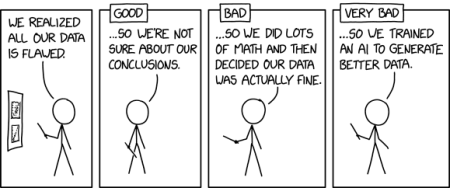
As I did not rush fast enough to Andrew’s Foundation lecture (another sequence of percolations!), I had to stand in the back of the packed main amphitheatre (and former sorting hall of the Venice slaughterhouse!), Guido Cazzavillan’s Aula Magna, while he talked a fresco about some holes in Bayesian data analysis (the analysis, not the book!), those being [verbatim]
- the usual rules of conditional probability fail in the quantum realm,
- flat or weak priors lead to terrible inferences about things we care about,
- subjective priors are incoherent,
- Bayesian decision picks the wrong model,
- Bayes factors fail in the presence of flat or weak priors,
- for Cantorian reasons we need to check our models, but this destroys the coherence of Bayesian inference.
After lunch, I attended the (mostly sequential) simulation based inference (renamed from ABC!) session with a composite likelihood proposal by Lorenzo Rimella, that uses marginals to approximate the likelihood of a hidden Markov SIS epidemic model by composite likelihood towards getting more efficient if inexact versions. Then [1WABC webinar co-organiser] Umberto Picchini on surrogates for likelihood and posterior functions, with sequential improvements (w/o ABC and w/o neural networks). Called “Sequential mixture posterior and likelihood estimation”, using mixtures of experts when the weights are functions of the observed or simulated y. With adapting the number of components in the mixture. Comparing favourably with normalising flows. And Wentao Li on correcting by ABC for composite likelihood as in Ruli et al. (2016). Where a posterior distribution given composite scores (seen as [summary] statistics) is employed but requires a convergent estimator of the unknown parameter.
No congratulation today to our PhD student who managed to fall in a canal (but survived)..!






 The main BayesComp meeting started right after the ABC workshop and went on at a grueling pace, and offered a constant conundrum as to which of the four sessions to attend, the more when trying to enjoy some outdoor activity during the lunch breaks. My overall feeling is that it went on too fast, too quickly! Here are some quick and haphazard notes from some of the talks I attended, as for instance the practical parallelisation of an SMC algorithm by Adrien Corenflos, the advances made by Giacommo Zanella on using Bayesian asymptotics to assess robustness of Gibbs samplers to the dimension of the data (although with no assessment of the ensuing time requirements), a nice session on simulated annealing, from black holes to Alps (if the wrong mountain chain for Levi), and the central role of contrastive learning à la Geyer (1994) in the GAN talks of Veronika Rockova and Éric Moulines. Victor Elvira delivered an enthusiastic talk on our massively recycled importance on-going project that we need to complete asap!
 In a not-solely-ABC session, I appreciated Sirio Legramanti speaking on comparing different distance measures via Rademacher complexity, highlighting that some distances are not robust, incl. for instance some (all?) Wasserstein distances that are not defined for heavy tailed distributions like the Cauchy distribution. And using the mean as a summary statistic in such heavy tail settings comes as an issue, since the distance between simulated and observed means does not decrease in variance with the sample size, with the practical difficulty that the problem is hard to detect on real (misspecified) data since the true distribution behing (if any) is unknown. Would that imply that only intrinsic distances like maximum mean discrepancy or Kolmogorov-Smirnov are the only reasonable choices in misspecified settings?! While, in the ABC session, Jeremiah went back to this role of distances for generalised Bayesian inference, replacing likelihood by scoring rule, and requirement for Monte Carlo approximation (but is approximating an approximation that a terrible thing?!). I also discussed briefly with Alejandra Avalos on her use of pseudo-likelihoods in Ising models, which, while not the original model, is nonetheless a model and therefore to taken as such rather than as approximation.


