Archive for The Guardian

Mark [a]B[c], plus cats

Posted in Books, Kids, pictures, Statistics, University life with tags , , , , , , , , , , , , , , , , , , , on June 22, 2024 by xi'an

30 May was a day of first and last times, if not in capital ways (for me), on the One World ABC webinar. This was the first time we had a talk by Mark Beaumont and also the first time I had team experience of facing a smoking participant, while this was the last time of our monthly webinar for the (Northern) academic year.

The talk was about model misspecification in population genomic, from an ABC perspective with the motivation of common noticeable difference between the distributions of d(s,s⁰) and d(s,s’), distances between the prior predictively simulated summary statistics and the observed ones vs posterior generated ones, which should indicates misspecification, esp with complicated models. Mark and his coauthors then supported a gradual elimination of summary statistics to diminish the discrepancy, hence voluntarily impoverishing the model. While blaming the statistics sounded a bit like shooting the messenger, the resolution is of obvious interest if backing from modelling the misspecification itself.

Some of the presented work was conducted in Ward et al (2022, NeurIPS) with a reference to the outlying Ratmann et al (2009) we later discussed, for including tolerance as an extra parameter ε, thereby reconsidering Wikinson’s exact ABC for noisy observations y by the medium of a normalising flow on the marginal distribution of the denoised x (learned from the prior predictive)

More precisely, the idea is to drop summary statistics by checking whether or not the observed S⁰ belongs to HPD region, removing one component of S at a time, using e.g. a k-NN estimate for the summary density (hence depending on parameterisation of said statistics for the distance). Hopefully, the process stops before loosing identifiability by using too few statistics. I also wondered at multiple uses of the data in this sequential procedure but Mark argued for adopting a meta- or pragma- or Gelmanian- Bayesian perspective in the end!

Another perk was the appearance of (and illustration with) the Scottish Wildcat, mentioned in The Guardian a few months ago and discussed in the ‘Og, with further papers exploring more aspects of this hybridization, like a posterior applied to a much more complex phylogenic tree reconstruction for cats of different creeds and many related parameters.
Nature tidbits

Posted in Books, Kids, Statistics, Travel, University life with tags , , , , , , , , , , , , , , , , , , , , , , , , , , , , , , , , , on June 10, 2024 by xi'an

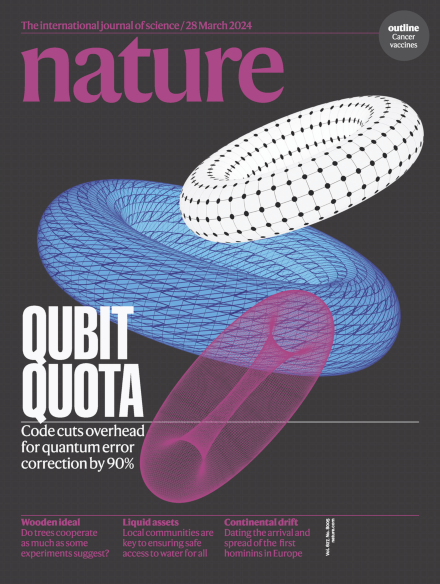
I was quite glad to have taken this 28 March issue of Nature for the train ride to Marseille earlier this month, as it proved full of great entries. Starting with a tribune from a PhD candidate from Ghana unable to speak at a tropical ecology conference in Lisbon for being denied a Schengen visa by the Dutch embassy in Accra, despite providing a serious amount of supporting material. This is a general issue related to international conferences that I plan to include in my presentation in a round table about the future of conference at the ISBA 2024 conference next month. Researchers and students from low-income countries are regularly victims of arbitrary rejections by consular and embassy officers, with little leeway from inviting universities and academic societies for counteracting such arbitrariness. An example came last year when, as part of our Data Science for Social Good program at Warwick, one computer student from Pakistan got denied a visa, while another one with an almost identical profile did receive her visa.

In News in focus, the development of a revolutionary (CAR-T) cancer therapy by  a Munbai company at 1/10 the cost of similar products in the US, with several impressive innovations (and a clinical trial over 33 people). The coverage of Michel Talagrand’s 2024 Abel prize, the deteriorating state of scientific research in Russia, a review on how the Big Bang got its name (hint: it was on BBC 3), and remembering India’s Chipko tree-hugging women of Western Himalayas of 50 years ago. The development of signs for scientific terms to add to the Indian and American sign languages.

There is also an almost sleuthing story on the debates in the ecology community about the theory of “Mother Tree”, introduced by Suzanne Simard, about trees communicating among themselves by underground fungal networks, and thus creating a “wood wide web“.  With mature trees favouring their own kin, a theory that critics in the field deem incompatible with evolutionary theory and more crucially missing supporting evidence. (Arguments from Simard that “the European male society hates the mother tree” concept do not help towards a rational denate. The Guardian now has a podcast about this debate.)

And another story on the (racial and gender) bias of AI image generators. With the conclusion that removing such biases goes through open sourcing. And regulation like the EU’s AI Act. that requires technical documentation on the training datasets. Plus a retrospective on the theory of bird-flight origins, with John Ostrom proposing in 1974 that the evolution to flight was ground-up rather than tree-down.

A cover-paper on IBM error correcting code for quantum computing that only requires each qubit to connect with six others (just like birds in murmuration only keep track of seven neighbours) for an error threshold less than 1%. (With the property that 12 logical qubits can be preserved for 10⁶ cyclces using 288 qubits in total.)

Aurora[ge]

Posted in Books, pictures, Travel with tags , , , , , , , , , on June 6, 2024 by xi'an

maths as catchy background [and no further future for humanity]

Posted in Books, pictures, University life with tags , , , , , , , , , , , on May 11, 2024 by xi'an

mixed news on the Western [abortion] front

Posted in Books, Kids, Travel with tags , , , , , , , , , , , , , , , , , , , , , , , , on May 6, 2024 by xi'an

In the past weeks, a mix of negative and positive moves about abortion in Europe and the USA (which among other bans resuscitated a 1864 near-total abortion ban in Arizona and saw sad-faced Mike Pence complain in TNYT (!) about mad-hatter and opportunist Donald Trump “retreat from the pro-life cause”):

France has added that “The law determines the conditions by which is exercised the freedom of women to voluntarily terminate a pregnancy, which is guaranteed” to the Article 34 of the French Constitution, which is intended to make access to abortion a fundamental right but still remains a formal move as it can be reinterpreted restrictively (which conditions?!) and does not state anything about the practical side of universally ensuring this access, which might be severely hindered by a dearth of willing practicians or the introduction of constraints on clinics, as seen for many years in the US, prior to the revocation of Roe vs. Wade.

Poland has seen its MPs from its lower house vote on four bills on abortion for further study, of which two propose legalising abortion until the 12th week of pregnancy and cancel the current quasi-complete ban on abortion.

Germany Bundestag is working on a bill that would outlaw the intimidation of people around abortion clinics offering abortion. The country should however more much further by making abortion legal, which is not the case now (even though there are “exceptions for abortions with counseling in the first trimester, and for medically necessary abortions [incl. or serious social or emotional distress] and abortions due to unlawful sexual acts”) and actual access to abortion practitioners proves a challenge. The Christian Democratic Union (CDU) and the far-right Alternative für Deutschland (AfD) are unsurprisingly opposing this legalisation.

Italy saw Meloni’s far-right government allowing anti-abortion activists to enter abortion consultation clinics!!, as part of a package of measures funded by the EU!!!. with the [newspeak] argument that they “must not criminalise those who are against abortion. [The Government has] always allowed freedom of conscience on issues of this kind [and] believe it is right for everyone to behave according to their own beliefs and conscience.”