Archive for The Riddler

easy and uneasy riddles

Posted in Books, Kids, R with tags , , , , , on February 2, 2021 by xi'an

On 15 January, The Riddler had both a straightforward and a challenging riddles. The first one was to optimise the choice of a real number d with the utility function U(d,θ)=d ℑ(θ>d), when θ is Uniform(0,100). Leading unsurprisingly to d=50…

The tough(er) one was to solve a form of sudoku where the 24 entries of a 8×3 table are integers in {1,…,9} and the information is provided by the row-wise and column-wise products of these integers. The vertical margins are

294, 216, 135, 98, 112, 84, 245, 40

and the horizontal margins are

8 890 560, 156 800, 55 566

After an unsuccessful brute-force (and pseudo-annealed) attempt achieving a minimum error of 127, although using the prime factor decompositions of these 11 margins, I realised that some entries were known: e.g., 7 at (1,2), 5 at (3,2), and 7 at (7,3), and (much later) that the (huge) product value for the first column implied that each term in that column had to be the maximal possible value for the corresponding rows, except for 5 on row 7. This leads to the starting grid

    [,1] [,2] [,3]
[1,]    7    7    6
[2,]    9    0    0
[3,]    9    5    3
[4,]    7    0    0
[5,]    8    0    0
[6,]    7    0    0
[7,]    5    7    7
[8,]    8    0    0

and an additional and obvious exclusion based on the absence of 3’s in the second column, of 5’s and 2’s in the third column shows there was a unique solution

    [,1] [,2] [,3]
[1,]    7    7    6
[2,]    9    8    3
[3,]    9    5    3
[4,]    7    2    7
[5,]    8    2    7
[6,]    7    4    3
[7,]    5    7    7
[8,]    8    5    1

as also demonstrated by a complete exploration with R:

Try it online!

dial e for Buffon

Posted in Books, Kids, Statistics with tags , , , , , , , on January 29, 2021 by xi'an

The use of Buffon’s needle to approximate π by a (slow) Monte Carlo estimate is a well-known Monte Carlo illustration. But that a similar experiment can be used for approximating e seems less known, if judging from the 08 January riddle from The Riddler. When considering a sequence of length n exchangeable random variables, the probability of a particuliar ordering of the sequence is 1/n!. Thus, counting how many darts need be thrown on a target until the distance to the centre increases produces a random number N≥2 with pmf 1/n!-1/(n+1)! and with expectation equal to e. Which can be checked as follows

p=diff(c(0,1+which(diff(rt(1e5))>0)))
sum((p>1)*((p+1)*(p+2)/2-1)+2*(p==1))

which recycles simulations by using every one as starting point (codegolfers welcome!).

An earlier post on the ‘Og essentially covered the same notion, also linking it to Forsythe’s method and to Gnedenko. (Rényi could also be involved!) Paradoxically, the extra-credit given to the case when the target is divided into equal distance tori is much less exciting…

puzzles & riddles

Posted in Books, Kids, R, Statistics with tags , , , , , , , , on January 3, 2021 by xi'an

A rather simplistic game on the Riddler of 18 December:

…two players, each of whom starts with a whole number of points. Players take turns “attacking” each other, which involves subtracting their own number of points from their opponent’s until one of the players is out of points.

Easy to code in R:

g=function(N,M)ifelse(N<M,-g(M-N,N),1)

f=function(N,M=N){
  while(g(N,M)>0)M=M+1
  return(M)}

which converges to the separating ratio 1.618. If decomposing the actions until one player wins, one gets a sequence of upper and lower bounds associated with the Fibonacci sequence: 1⁻, 2⁺, 3/2⁻, 5/3⁺, 8/5⁻, &tc, converging to the “golden ratio” φ.

As an aside, I also solved a relatively quick codegolf challenge, where the question was to find the sum of all possible binary values from a bitmask. Meaning that for a binary input, e.g., 101X0XX0…01X, with some entries masked by X’s, one had to find the sum of all binary numbers compatible with the input. Which can be solved succinctly by counting the number of X’s, k, and adding the visible bits 2^k times and replacing the invisible ones by  2^{k-1}. With some help, and using 2 instead of X, my R code moved from 158 bytes to 50:
function(x)2^sum(a<-x>1)*rev(x/4^a)%*%2^(seq(x)-1)

around the table

Posted in Books, pictures, R, Statistics with tags , , , , , , , , , , on December 2, 2020 by xi'an

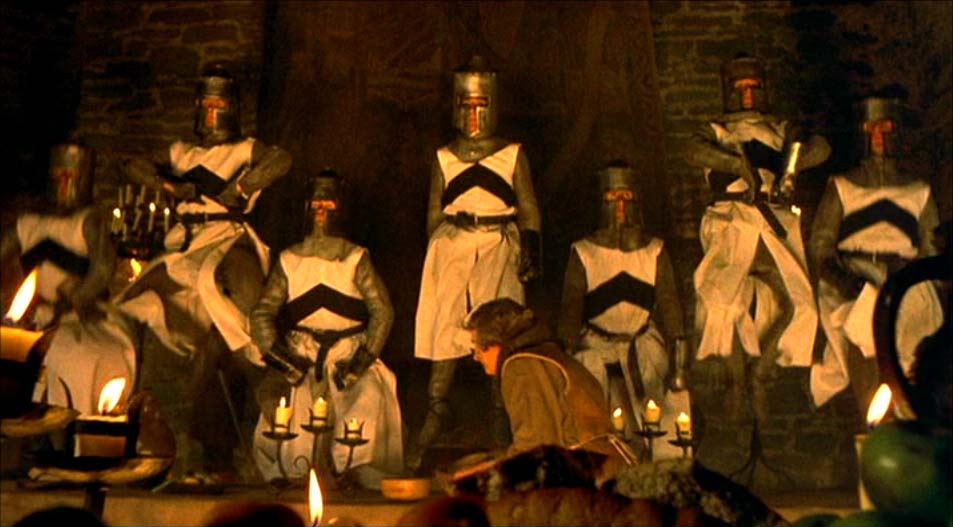
Monty Python and the Holy Grail: the round table in CamelotThe Riddler has a variant on the classical (discrete) random walk around a circle where every state (but the starting point) has the same probability 1/(n-1) to be visited last. Surprising result that stems almost immediately from the property that, leaving from 0, state a is visited couterclockwise before state b>a is visited clockwise is b/a+b. The variant includes (or seems to include) the starting state 0 as counting for the last visit (as a return to the origin). In that case, all n states, including the origin, but the two neighbours of 0, 1, and n-1, have the same probability to be last. This can also be seen on an R code that approximates (inner loop) the probability that a given state is last visited and record how often this probability is largest (outer loop):

w=0*(1:N)#frequency of most likely last
for(t in 1:1e6){
 o=0*w#probabilities of being last
 for(v in 1:1e6)#sample order of visits
   o[i]=o[i<-1+unique(cumsum(sample(c(-1,1),300,rep=T))%%N)[N]]+1
 w[j]=w[j<-order(o)[N]]+1}

However, upon (jogging) reflection, the double loop is a waste of energy and

o=0*(1:N)
for(v in 1:1e8)
   o[i]=o[i<-1+unique(cumsum(sample(c(-1,1),500,rep=T))%%N)[N]]+1

should be enough to check that all n positions but both neighbours have the same probability of being last visited. Removing the remaining loop should be feasible by considering all subchains starting at one of the 0’s, since this is a renewal state, but I cannot fathom how to code it succinctly. A more detailed coverage of the original problem (that is, omitting the starting point) was published the Monday after publication of the riddle on R bloggers, following a blog post by David Robinson on Variance Explained.

R codegolf challenge: is there a way to shorten the above R for loop in a single line command?!

Bernoulli factory in the Riddler

Posted in Books, Kids, R, Statistics with tags , , , , , , , , , , on December 1, 2020 by xi'an

“Mathematician John von Neumann is credited with figuring out how to take a p biased coin and “simulate” a fair coin. Simply flip the coin twice. If it comes up heads both times or tails both times, then flip it twice again. Eventually, you’ll get two different flips — either a heads and then a tails, or a tails and then a heads, with each of these two cases equally likely. Once you get two different flips, you can call the second of those flips the outcome of your “simulation.” For any value of p between zero and one, this procedure will always return heads half the time and tails half the time. This is pretty remarkable! But there’s a downside to von Neumann’s approach — you don’t know how long the simulation will last.” The Riddler

The associated riddle (first one of the post-T era!) is to figure out what are the values of p for which an algorithm can be derived for simulating a fair coin in at most three flips. In one single flip, p=½ sounds like the unique solution. For two flips, p²,(1-p)^2,2p(1-p)=½ work, but so do p+(1-p)p,(1-p)+p(1-p)=½, and the number of cases grows for three flips at most. However, since we can have 2³=8 different sequences, there are 2⁸ ways to aggregate these events and thus at most 2⁸ resulting probabilities (including 0 and 1). Running a quick R code and checking for proximity to ½ of any of these sums leads to

[1] 0.2062997 0.7937005 #p^3
[1] 0.2113249 0.7886753 #p^3+(1-p)^3
[1] 0.2281555 0.7718448 #p^3+p(1-p)^2
[1] 0.2372862 0.7627143 #p^3+(1-p)^3+p(1-p)^2
[1] 0.2653019 0.7346988 #p^3+2p(1-p)^2
[1] 0.2928933 0.7071078 #p^2
[1] 0.3154489 0.6845518 #p^3+2p^2(1-p)
[1] 0.352201  0.6477993 #p^3+p(1-p)^2+p^2(1-p)
[1] 0.4030316 0.5969686 #p^3+p(1-p)^2+3(1-p)p^2
[1] 0.5

which correspond to

1-p³=½, p³+(1-p)³=½,(1-p)³+(1-p)p²=½,p³+(1-p)³+p²(1-p),(1-p)³+2(1-p)p²=½,1-p²=½, p³+(1-p)³+p²(1-p)=½,(1-p)³+p(1-p)²+p²(1-p)=½,(1-p)³+p²(1-p)+3p(1-p)²=½,p³+p(1-p)²+3(p²(1-p)=½,p³+2p(1-p)²+3(1-p)p²=½,p=½,

(plus the symmetric ones), leading to 19 different values of p producing a “fair coin”. Missing any other combination?!

Another way to look at the problem is to find all roots of the 2^{2^n} equations

a_0p^n+a_1p^{n-1}(1-p)+\cdots+a_{n-1}p(1-p)^{n-1}+a_n(1-p)^n=1/2

where

0\le a_i\le{n \choose i}

(None of these solutions is rational, by the way, except p=½.) I also tried this route with a slightly longer R code, calling polyroot, and finding the same 19 roots for three flips, [at least] 271 for four, and [at least] 8641 for five (The Riddler says 8635!). With an imprecision in the exact number of roots due to rather poor numerical rounding by polyroot. (Since the coefficients of the above are not directly providing those of the polynomial, I went through an alternate representation as a polynomial in (1-p)/p, with a straightforward derivation of the coefficients.)